
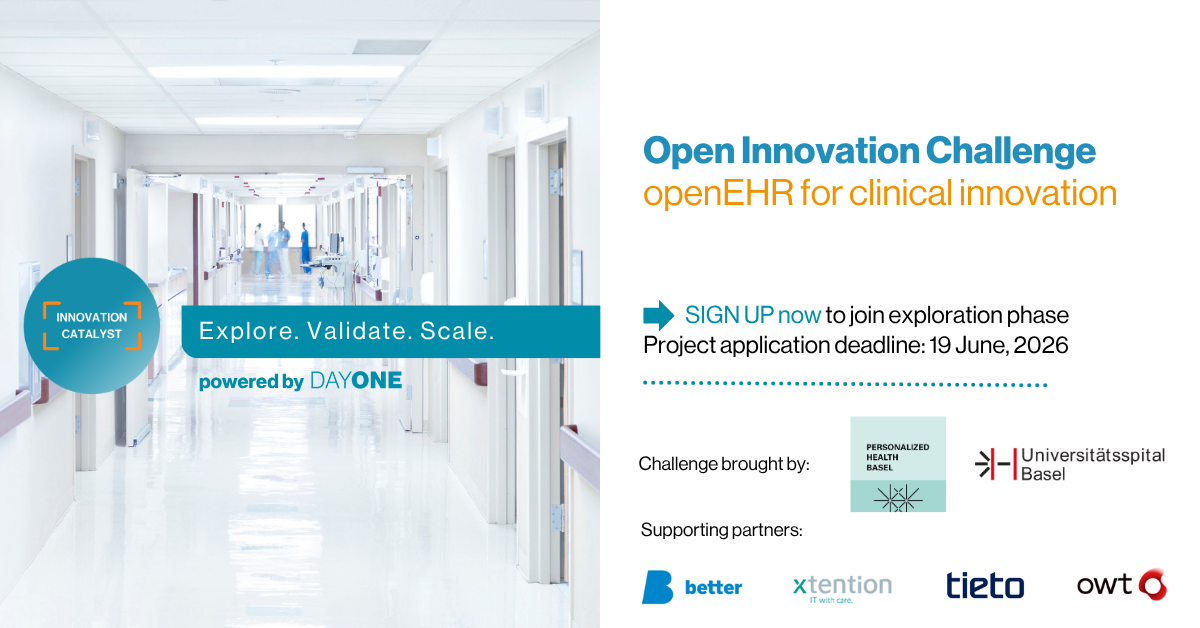
Building the Future of Clinical Innovation with openEHR
Healthcare innovation often runs into the same barrier: promising ideas struggle to translate into everyday clinical practice. Systems don’t communicate seamlessly, workflows become fragmented, and data – despite its growing importance – remains underutilized. The Open Innovation Challenge 2026: openEHR for Clinical Innovation is designed to address exactly these gaps.
At its core, the challenge is about co-developing digital health solutions that are not only technically sound, but truly usable in clinical environments. By leveraging the openEHR platform, participants are invited to build interoperable solutions that streamline workflows, improve data quality and, ultimately, enhance patient outcomes.
Grounded in real clinical needs
What sets this challenge apart is its strong clinical anchoring. Brought by Personalized Health Basel together with University Hospital Basel, the initiative is built around real use cases identified by clinicians themselves. This ensures that innovation doesn’t happen in isolation, but in direct response to concrete needs within the hospital setting.
Participants will have the opportunity to engage with clinical experts throughout the process – gaining insights, validating assumptions and shaping solutions that can realistically be implemented and scaled.
A collaborative journey from idea to validation
The challenge unfolds over several months, beginning with an open exploration phase and culminating in a hands-on validation program.
During the April–June 2026 exploration phase, participants can join the community, attend webinars, and take part in events designed to deepen their understanding of the use cases. It’s also a chance to connect with potential collaborators and refine early ideas.
A key moment in this phase is the Open Innovation Day on 1 June 2026 in Basel, where participants come together for a full day of exchange, discussion and co-creation. Following this, teams will finalize and submit their proposals by 19 June 2026.
Shortly after, up to ten teams will be invited to pitch their ideas during a virtual selection day on 24 June 2026. From these, five teams will be selected to move forward.
The July–October 2026 validation phase is where ideas are put to the test. Selected teams will work closely with clinical champions at University Hospital Basel, supported by mentorship, access to a research data environment and a structured development process. The goal is clear: move from concept to a validated, real-world solution.
The journey concludes in October 2026 with a Demo Day, where teams present their progress from idea to minimum viable products (MVPs). A CHF 10,000 award will be given to the winning project – but the broader value lies in the opportunity to build something that can make a tangible impact in healthcare.
Focus areas: Three high-impact use cases
This year’s challenge focuses on three areas where innovation can make a meaningful difference:
Hospital at Home
Exploring how hospital-level care can be extended beyond hospital walls, enabling continuous monitoring and coordinated care for patients recovering at home.
SOP & Clinical Decision Support
Translating clinical guidelines into real-time, actionable decision support embedded directly into clinical workflows.
Molecular Tumour Board
Integrating complex molecular diagnostic data into clinical records to support treatment decisions in oncology, with a strong emphasis on traceability and clinician trust.
Each of these use cases reflects broader challenges in modern healthcare and highlights the importance of interoperable, scalable solutions built on shared standards like openEHR.
An open invitation to innovate
The Open Innovation Challenge is open to startups, research teams, hospitals and established companies working in digital health worldwide – participation is not limited to Swiss organizations. Whether you’re developing a new solution or adapting an existing one, the program offers a unique opportunity to collaborate directly with clinicians, validate your approach and accelerate your path toward implementation.
Participants are encouraged to join early, engage with the available activities and use the coming months to shape ideas that are both ambitious and grounded in reality.
How to get involved
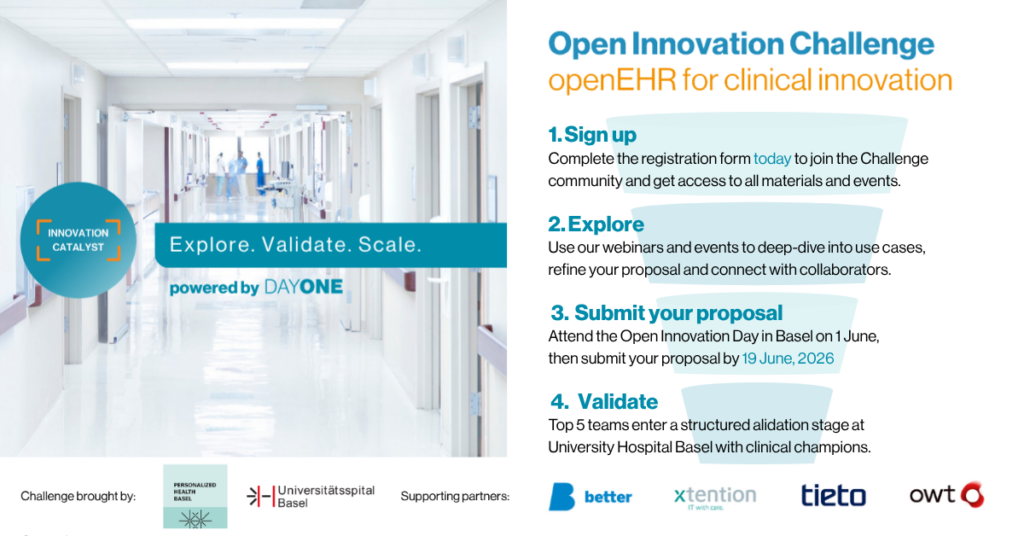
Getting started is simple:
- Register via the online form to join the Challenge community
- Take part in webinars and events to explore the use cases
- Attend the Open Innovation Day in Basel
- Submit your proposal by 19 June 2026
From there, the most promising Top 5 projects will move forward into a structured validation process bringing them one step closer to real-world impact, finishing with a Demo Day and a CHF 10,000 Award.
The future of healthcare won’t be built in silos. It will be co-created – across disciplines, institutions, and technologies. This challenge is an open invitation to be part of that transformation.
Alongside Personalized Health Basel and University Hospital Basel, this challenge is also supported by partners Better, x-tention, Tieto and OWT (a Swisscom company). Innovation Catalyst is powered by DayOne.
Find out more about the previous challenge outcomes: Using openEHR to Improve Clinical Data Capture.
Building the Future of Clinical Innovation with openEHR
Healthcare innovation often runs into the same barrier: promising ideas struggle to translate into everyday clinical practice. Systems don’t communicate seamlessly, workflows become fragmented, and data – despite its growing importance – remains underutilized. The Open Innovation Challenge 2026: openEHR for Clinical Innovation is designed to address exactly these gaps.
At its core, the challenge is about co-developing digital health solutions that are not only technically sound, but truly usable in clinical environments. By leveraging the openEHR platform, participants are invited to build interoperable solutions that streamline workflows, improve data quality and, ultimately, enhance patient outcomes.
Grounded in real clinical needs
What sets this challenge apart is its strong clinical anchoring. Brought by Personalized Health Basel together with University Hospital Basel, the initiative is built around real use cases identified by clinicians themselves. This ensures that innovation doesn’t happen in isolation, but in direct response to concrete needs within the hospital setting.
Participants will have the opportunity to engage with clinical experts throughout the process – gaining insights, validating assumptions and shaping solutions that can realistically be implemented and scaled.
A collaborative journey from idea to validation
The challenge unfolds over several months, beginning with an open exploration phase and culminating in a hands-on validation program.
During the April–June 2026 exploration phase, participants can join the community, attend webinars, and take part in events designed to deepen their understanding of the use cases. It’s also a chance to connect with potential collaborators and refine early ideas.
A key moment in this phase is the Open Innovation Day on 1 June 2026 in Basel, where participants come together for a full day of exchange, discussion and co-creation. Following this, teams will finalize and submit their proposals by 19 June 2026.
Shortly after, up to ten teams will be invited to pitch their ideas during a virtual selection day on 24 June 2026. From these, five teams will be selected to move forward.
The July–October 2026 validation phase is where ideas are put to the test. Selected teams will work closely with clinical champions at University Hospital Basel, supported by mentorship, access to a research data environment and a structured development process. The goal is clear: move from concept to a validated, real-world solution.
The journey concludes in October 2026 with a Demo Day, where teams present their progress from idea to minimum viable products (MVPs). A CHF 10,000 award will be given to the winning project – but the broader value lies in the opportunity to build something that can make a tangible impact in healthcare.
Focus areas: Three high-impact use cases
This year’s challenge focuses on three areas where innovation can make a meaningful difference:
Hospital at Home
Exploring how hospital-level care can be extended beyond hospital walls, enabling continuous monitoring and coordinated care for patients recovering at home.
SOP & Clinical Decision Support
Translating clinical guidelines into real-time, actionable decision support embedded directly into clinical workflows.
Molecular Tumour Board
Integrating complex molecular diagnostic data into clinical records to support treatment decisions in oncology, with a strong emphasis on traceability and clinician trust.
Each of these use cases reflects broader challenges in modern healthcare and highlights the importance of interoperable, scalable solutions built on shared standards like openEHR.
An open invitation to innovate
The Open Innovation Challenge is open to startups, research teams, hospitals and established companies working in digital health worldwide – participation is not limited to Swiss organizations. Whether you’re developing a new solution or adapting an existing one, the program offers a unique opportunity to collaborate directly with clinicians, validate your approach and accelerate your path toward implementation.
Participants are encouraged to join early, engage with the available activities and use the coming months to shape ideas that are both ambitious and grounded in reality.
How to get involved
Getting started is simple:
- Register via the online form to join the Challenge community
- Take part in webinars and events to explore the use cases
- Attend the Open Innovation Day in Basel
- Submit your proposal by 19 June 2026
From there, the most promising Top 5 projects will move forward into a structured validation process bringing them one step closer to real-world impact, finishing with a Demo Day and a CHF 10,000 Award.
The future of healthcare won’t be built in silos. It will be co-created – across disciplines, institutions, and technologies. This challenge is an open invitation to be part of that transformation.
Alongside Personalized Health Basel and University Hospital Basel, this challenge is also supported by partners Better, x-tention, Tieto and OWT (a Swisscom company). Innovation Catalyst is powered by DayOne.
Find out more about the previous challenge outcomes: Using openEHR to Improve Clinical Data Capture.

Leave a Reply