
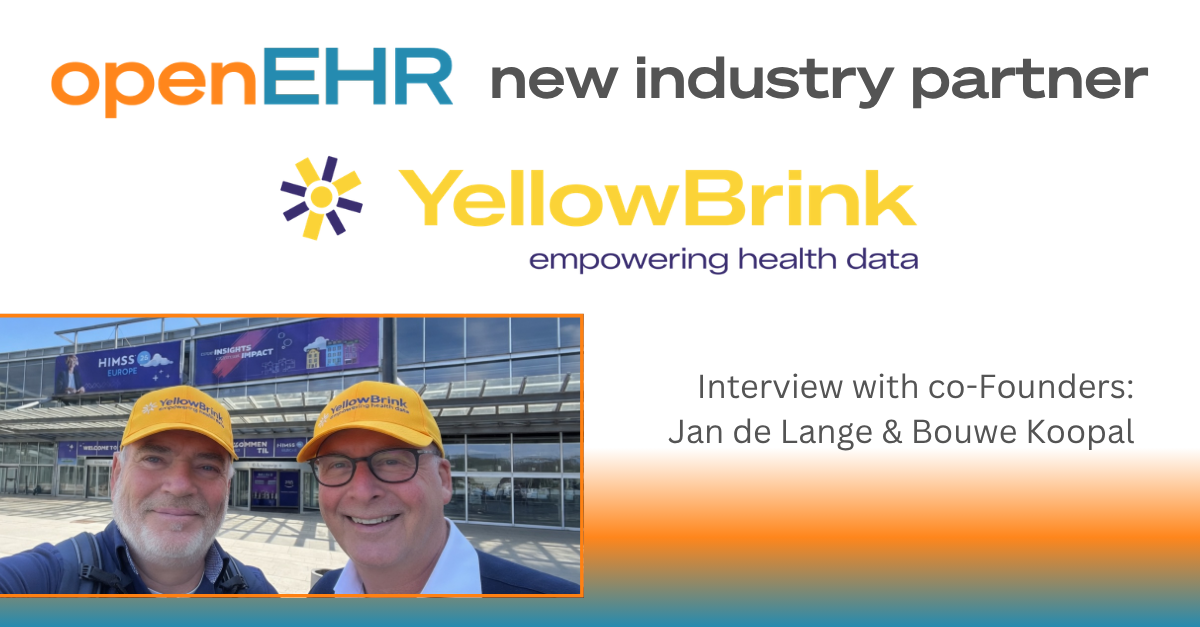
Healthcare organisations around the world face many of the same challenges, but too often they tackle them in isolation. In this interview, YellowBrink founders Jan de Lange and Bouwe Koopal discuss their journey into openEHR, the lessons learned from building international communities, and why connecting people, knowledge and experience is essential for accelerating healthcare innovation.
Let’s start with introductions. Who are you, and what is YellowBrink?
Jan: I’m Jan de Lange. My background is in strategic marketing, specifically in healthcare innovation. Over the past several years I’ve been deeply involved in openEHR education – running Masterclass programmes, webinars, building networks across Europe. YellowBrink grew directly out of that work.
Bouwe: And I’m Bouwe Koopal. I’ve spent more than 35 years working across medicine, medical informatics, and information management. My background bridges clinical practice and software engineering, so I’ve always sat at that intersection between how care actually works and how data systems need to support it. I’ve been an advocate for openEHR and open standards for a long time. Jan and I founded YellowBrink together because we kept arriving at the same conclusions from very different directions.
Jan, how did your journey into this space begin?
In 2018 I made a deliberate decision to focus on digital innovation in healthcare. That’s really where everything started.
I began attending global conferences – London and others – just to understand what was actually happening in the field. What struck me quite quickly was that I was often the only Dutch-speaking visitor in the room. That told me something.
Healthcare people rarely look beyond their own organisation, let alone their own country. So you end up with these islands. On one island, people are spending years solving a problem that’s already been solved somewhere else. On another island, they’re three years ahead. Meanwhile, enormous amounts of time and money are being wasted on reinventing the wheel.
And that led you to openEHR?
Jan: Indirectly, yes. I started trying to connect organisations that were building interesting things, and I kept running into the same wall: fragmented systems, incompatible EHRs. Then I spent time in the Nordics and came across openEHR. I could see it was part of the solution.
So, I got deeply involved – talking to people, building relationships. That’s where I met Hanna Pohjonen, who had real expertise in openEHR education. Together we developed the openEHR Masterclass.
Bouwe: What Jan encountered in the Nordics is something I’d been watching for years from the technical side. The fragmentation problem in healthcare data isn’t just an inconvenience, it’s a fundamental architectural failure. openEHR addresses that at the root. The clinical models are separated from the technical infrastructure, which means systems can actually talk to each other in a meaningful way, not just superficially. When Jan and I started talking, it became clear pretty quickly that we were both trying to solve the same problem: he from the awareness and community side, me from the implementation and architecture side.
Jan, what was the thinking behind the Masterclass?
Two things, really. First, awareness. When I came back to the Netherlands from the Nordics, nobody knew what openEHR was. Companies like Nedap and Code24 had been working with it for years but never talked about it publicly. I thought that needed to change.
Second, community. Hanna developed online courses and I organised webinars where we’d invite people from different countries to share what they were doing: best-practice examples like One London and Karolinska. We ran that for four years, built a large network of translators, and developed a real community around data availability.
Did anything surprise you along the way?
Jan: Quite a lot, honestly. I once arranged a knowledge session with the Dutch Ministry of Health, Welfare and Sports. To prepare for the meeting, I did a kind of virtual tour of the Netherlands – contacting every organisation I knew was using openEHR and asking them: how are you using it, why, what’s your vision? I asked each to prepare three slides and brought them all with me.
What struck me was that organisations like Princess Máxima Children’s Oncology, which were doing genuinely advanced work with openEHR, had no idea who else in the Netherlands was doing similar things. They were completely invisible to each other.
What else came out of the Masterclass?
Jan: People would finish the programme, then come back a month or two later saying: we understand openEHR now, it’s great, but where do we actually find products? Which applications exist? How do we take the first step?
It’s a bit like getting a driving licence. You pass the theory, but you still need someone sitting next to you in the car saying: turn left here, watch out for that! People were really looking for peers, and for the exchange of experience, knowledge, and practical vision.
Was there a moment that crystallised the need for YellowBrink specifically?
Jan: There was, yes. We combined ICT & Health World Conference Maastricht, together with Maastricht University Medical Center (MUMC) and Igor Schoonbrood with a special interest meeting on open data standards. It was a special session for around 70 data specialists from the Netherlands. The conference finished at 4:30. We’d planned an evening session for openEHR discussion, and people stayed until 11 at night. After a full conference day.
They were genuinely energised, sharing data, sharing knowledge, debating where the market was going. But then everyone went home. Six months later they’d meet again at another conference. In between, they had problems and questions and nowhere to go.
Bouwe: That’s a pattern I’d seen repeatedly over the years. Brilliant people, genuine willingness to collaborate, but no infrastructure to sustain it. Conferences create sparks, but sparks need somewhere to land. That’s really what YellowBrink is built to be – the place where the energy doesn’t just dissipate.
So tell us about YellowBrink. Where does the name come from?
Bouwe: Jan came up with it, but I think it captures what we’re doing very well.
Jan: “Yellow” is a nod to the Yellow Pages – who are the vendors, what products exist, what can you actually buy. “Brink” is a Dutch word for a village square, a place where people meet, eat, talk, hold events. We put the two together.
What are the foundations it’s built on?
Bouwe: Three pillars. First, connection – people need to find each other before anything else can happen. Second, knowledge exchange – experiences, visions, what’s working and what isn’t. And from those two, the third follows naturally: collaboration and co-creation. That’s ultimately what we’re here for.
The platform is vendor-neutral, and that’s non-negotiable for us. We’re not here to push any particular product or commercial agenda. We’re here to advance open standards – HL7 FHIR, openEHR, OMOP, SNOMED CT – because we genuinely believe those are the foundation of a sustainable healthcare data ecosystem.
What does it look like day to day?
Bouwe: We run one webinar every week on different topics. We’ve had sessions with One London, Cadasto on their new openEHR CDR, Gasper on OpenFHIR, Rinke Riezebos from Princess Máxima presenting his work, and plenty of others. Jan is currently working on arranging something with Suzy Roy from SNOMED.
From the webinars, real discussions begin. On the platform, people can form special interest groups, introduce themselves, run smaller sessions, use discussion rooms, brainstorm together, collaborate. We’re constantly pushing toward more co-creation.
Education is also a major focus. Can you tell us about that?
Jan: It’s really important. Most of the openEHR momentum right now is being driven by technicians, engineers, and architects – people who understand intuitively why it matters. But at the executive level, in hospitals and regional organisations, the added value often isn’t understood. Boards hesitate to make decisions because adopting openEHR can mean replacing legacy systems, and that’s a difficult conversation.
Bouwe: And that’s a real problem, because the technology is ready. The standards are mature. What’s missing in many places is leadership that understands why this matters and has the confidence to commit. You can have the best architecture in the world, but if the board doesn’t understand what they’re approving, it stalls.
Jan: So we’re developing a postdoctoral MBA-like programme together with European universities, university hospitals and vendors from the ecosystem, and connected internationally with organisations like MUMC, Karolinska, and Charité. We’re calling it the European Master of Data Availability (MDA). It goes beyond openEHR – FHIR, OMOP, SNOMED, AI, low-code and no-code development, management tools. It’s designed for three disciplines: care professionals, technical experts and managers/board members: the people who actually need to make the decisions.
Finally – what’s the big picture? What are you ultimately trying to achieve?
Jan: Honestly, it just seems such a waste that everyone is working on separate islands. The Nordics are significantly ahead of the rest of Europe. Parts of the UK are ahead in some areas, behind in others. We want to identify the best thinking from every island and let everyone else learn from it quickly. Organisations like Karolinska are genuinely willing to share: here’s what worked, here’s what didn’t, here’s what you should avoid. That kind of knowledge transfer lets others skip years of expensive trial and error.
Bouwe: And once organisations reach a broadly similar level, something interesting becomes possible: genuine co-creation. Not just learning from each other, but building new things together. That’s where the real innovation happens; not on isolated islands, but across a connected ecosystem. That’s the future we’re working toward with YellowBrink.


Leave a Reply