
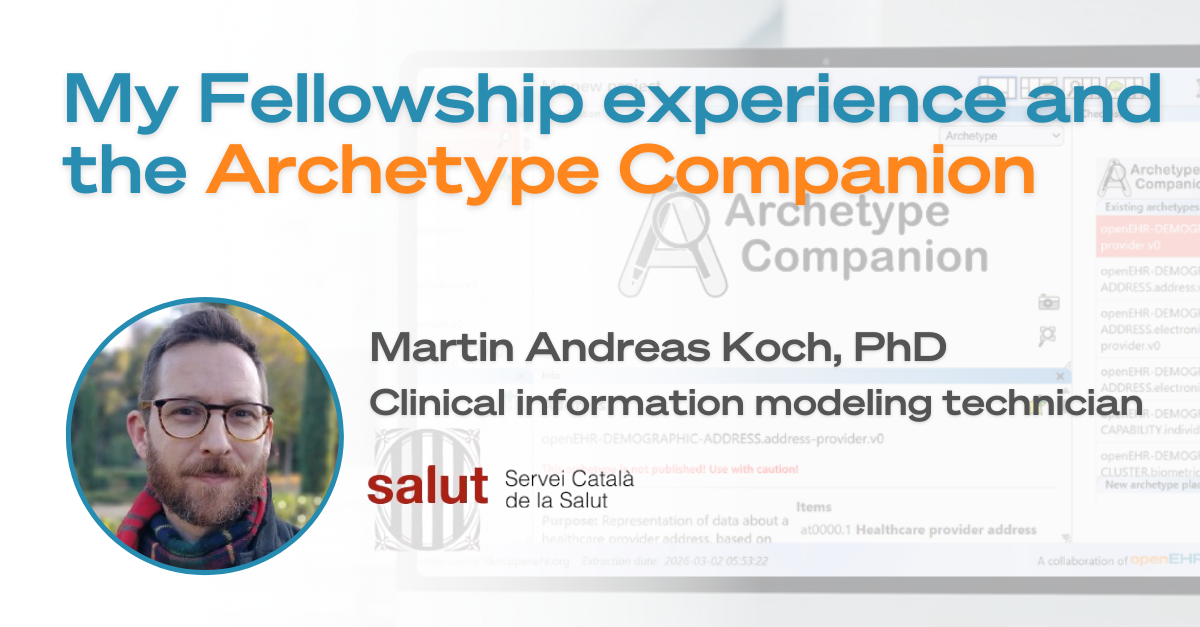
When I applied for the openEHR fellowship, we had a question with no simple answer:
“How can we make the openEHR archetype ecosystem easier to navigate and understand?“
Over the course of the fellowship, that question took me on a journey deep into the reality of archetype and template design.
This blog post is a reflection on that journey and an introduction to the concrete result that came out of it: the Archetype Companion.
One “critical moment” in modelling on which everything hinges
In general, the real-life development work we are doing starts with collecting the clinical data elements that are important for the use case we are addressing, and ends with a data structure – a template in openEHR terms.
This development work is rarely linear and goes through different loops, setbacks and pivots. But there is one critical moment that consistently shapes everything that follows: the moment when clinical data elements are assigned to openEHR archetypes.
At this point, the clinical modeller must ask:
- Which existing openEHR archetypes already fit these data elements?
- Which archetypes mostly fit, but should be adapted via a change request?
- Which archetypes do not exist yet and need to be created anew?
These questions are important because they represent the core philosophy of openEHR: reuse before reinvention. Handled well, this leads to shared models, aligned expectations, and interoperable implementations. Handled poorly, it can result in duplication and local “variants” that are hard to reconcile later.
What I heard from the community
One of my first steps in the project was to connect with the possible user base. I found that users would benefit from better tool integration of the archetype search, to make it more effective.
My impression was that there was a clear opportunity: could we offer a small, focused companion that helps professionals at this critical moment by making the landscape easier to search and provide a process for planning with the archetypes?
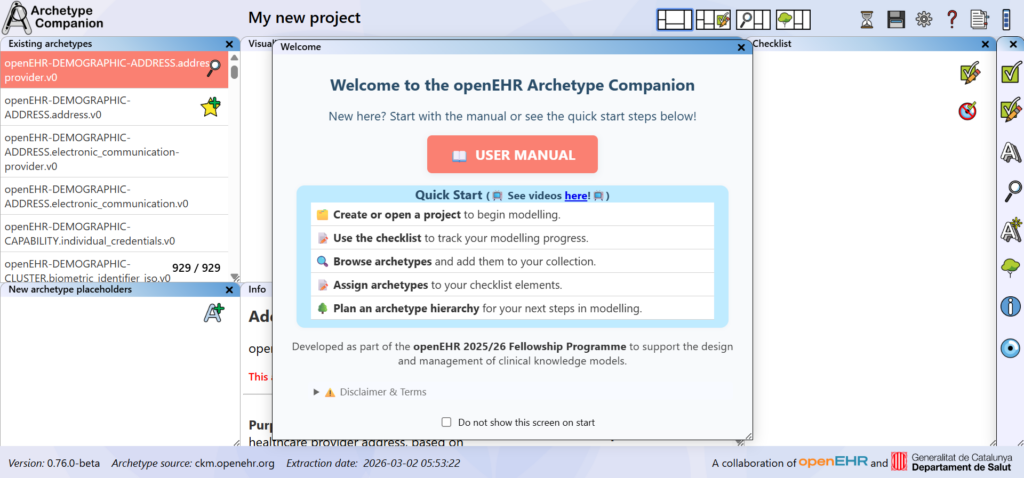
Introducing the Archetype Companion
The Archetype Companion is a lightweight tool designed to act as a sidekick, complementing existing openEHR modelling tools. The intention for the Archetype Companion is to be a community asset, built to serve the entire openEHR community.
At its core, the Archetype Companion aims to:
- Support the critical “data elements to archetypes” step
Help clinical knowledge modellers decide what to reuse, adapt, or create when designing data structures. - Enhance discoverability and understanding
Provide an intuitive way to search, explore, and visualise the archetype ecosystem so relevant archetypes are easier to find and assess. - Streamline modelling workflows and improve interoperability
Reduce friction in archetype work so that model development is faster and resulting data models are more consistent.
After months of development, I tested the Archetype Companion with real users. The responses were very constructive, and it seems that – in the words of one user – “it has the potential to become the most valuable and widely used tool in our workflow.”
Try the Archetype Companion: https://martinkochdesign.github.io/archetype_companion
A few lessons from the Fellowship Program
Working towards the Archetype Companion taught me a number of lessons about the openEHR ecosystem and community:
- openEHR is much more than just specifications
Through many opportunities to connect with the openEHR community, I got to know the people behind the work much better. It is truly a team effort, with many individuals contributing in different ways to create and sustain openEHR…and I am a part of it. - Clarity of purpose and time management matter
Having a clear idea of the project goal at the beginning is very important for a fellowship project. A realistic plan and time management are equally helpful in turning that goal into something concrete and deliverable. - Complexity is part of the work – and that’s where the value lies
In the spirit of “We do this not because it is easy, but because we thought it would be easy”, the project showed me how complexity can grow out of a clear initial idea that seemed straight forward. This journey into the unforeseen is what makes the fellowship so interesting: I ended up in a place where I have learned more than I expected.
My sincere thanks go to my mentor, Heather Leslie, and to everyone involved in the fellowship for their guidance, generosity, and trust throughout this journey. Their support helped to shape the Archetype Companion.
If you would like to join the 2026-27 openEHR Fellowship Program, you can apply here: https://docs.google.com/forms/d/e/1FAIpQLSdgaWEcqXJo2OmwEq1Ja68q5Ja94ifKX5YcTAiQhNtW-_rybQ/viewform?usp=sharing&ouid=107143400913220556264
Leave a Reply