
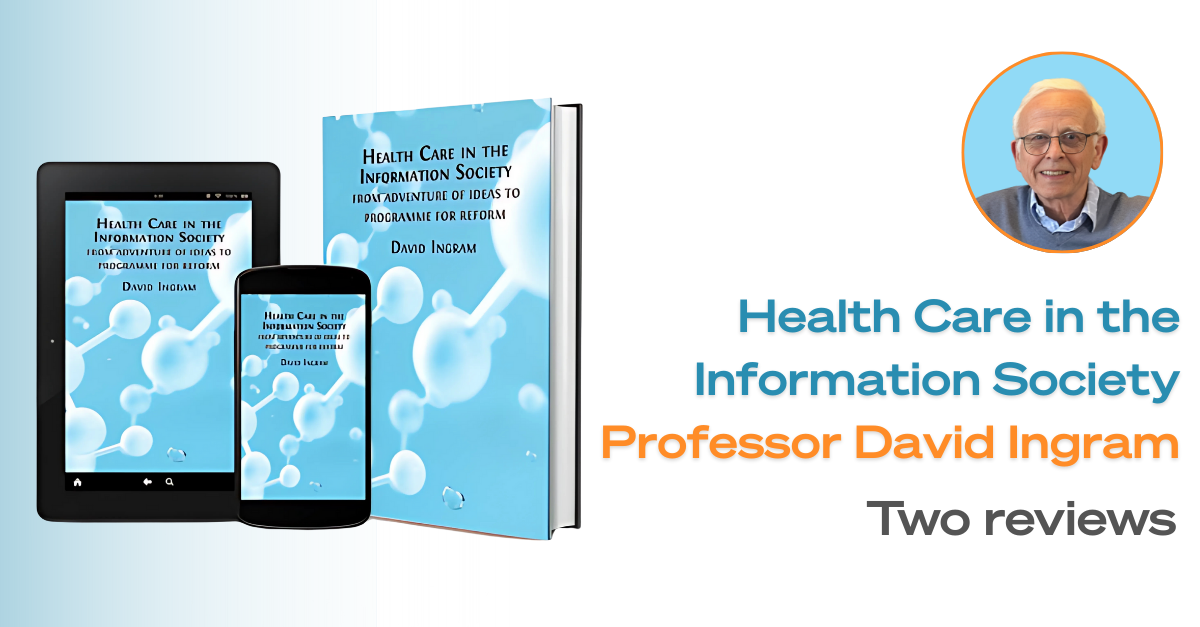
Two reviews of Health Care in the Information Society from different front lines, nonetheless arrive at the same conclusion about why David Ingram’s work matters now. Read together, they frame the two volumes not as abstract theory but rather as a practical understanding of how health information has evolved and what it would take to rebuild it as a public good for both clinicians and patients…
“This is not a book I read once and shelved. It is a book I work with, a companion for the long and difficult march of implementation.”
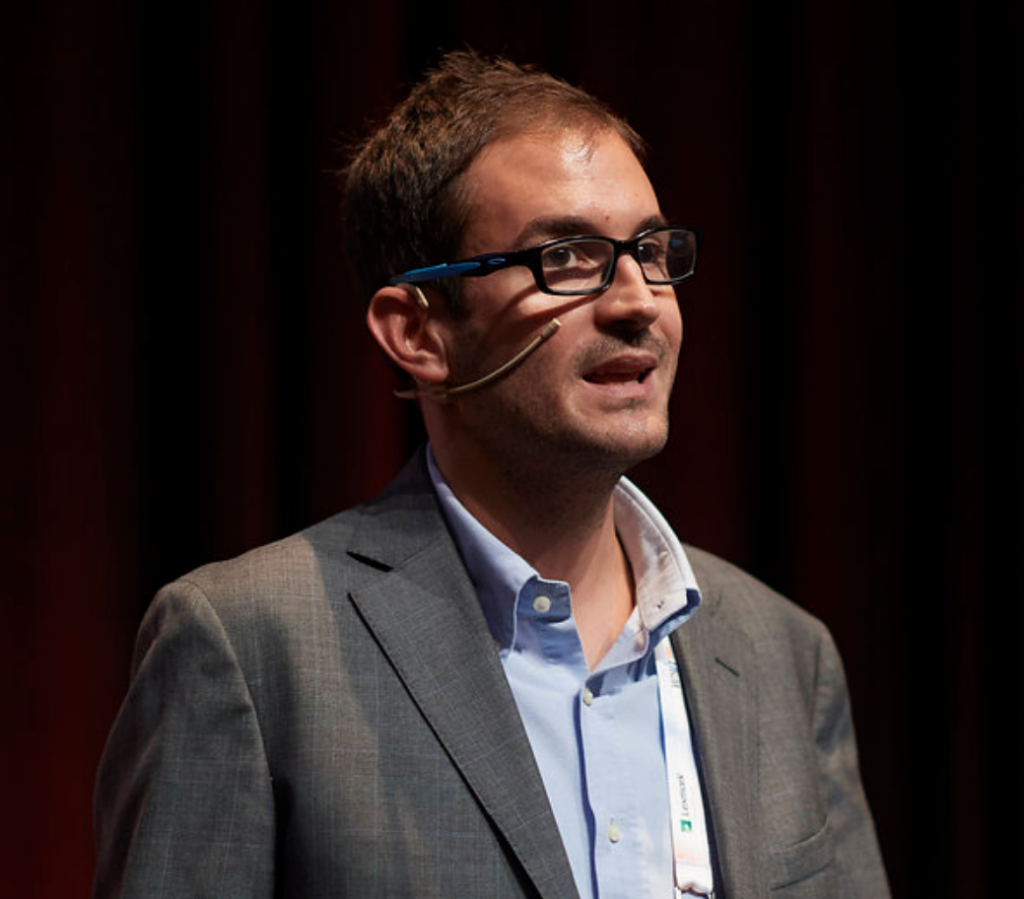
From the trenches of regional health IT transformation – Dr Jordi Piera-Jiménez is Director of Digital Health Strategy for the Catalan Health Service and a member of the Board of Directors of openEHR International.
My signed copies of David Ingram’s two volumes sit on my desk with over a hundred sticky notes marking passages I have returned to again and again. This is not a book I read once and shelved. It is a book I work with, a companion for the long and difficult march of implementation.
My journey with the ideas in this book began in 2013, when I was CIO of a hospital in Badalona (Catalonia, Spain), trying to build a federated electronic health record for small and medium-sized hospitals. That was when I first encountered openEHR as a possible path forward. It took until 2017 to embed these ideas into Catalonia’s first digital health strategy, and until 2020 to convince enough stakeholders that this was the way to go. I came to know David personally in 2022 when I joined the openEHR board of directors. We have since maintained a warm correspondence, and I had the honour of bringing him to speak at the first openEHR conference in Barcelona.
I write, therefore, not as an outside observer but as someone who has spent over a decade trying to build what David describes, and who has learned, sometimes painfully, what it actually takes.
The gift of the book
Ingram’s achievement is remarkable. He has produced an eyewitness account of fifty years of health informatics, told not as a dry chronicle but as a songline: a narrative of people, ideas, and the communities that carried them forward. Volume 1 traces the adventure of ideas that made health informatics possible. Volume 2 confronts the “anarchy of transition” we still inhabit and sets out a programme for reform centred on the Care Information Utility: health information as a public good, like water or electricity, built on open standards and governed for citizens.
For those of us labouring in this field, I believe the book provides something essential: validation. It names what we have felt but struggled to articulate with words. It places our daily frustrations within a larger historical timeframe and reminds us that the difficulties we face are not mere accidents but consequences of choices made, and choices that can be made differently.
The space between architecture and adoption
And yet, as I read Part Three (the programme for reform) I find myself lingering in the gap between the what and the how. David articulates with clarity what is needed and why. But the space in which the technical, the functional, and the governance intersect is where I have spent my working life, and it is treacherous ground.
The multi-stakeholder environment is complex, certainly. Governments operate on short electoral cycles and do not really understand the power of digital transformation; vendors have commercial incentives toward selling old technology from the shelf and locking-in clients; clinicians are burdened by healthcare delivery pressure, workforce shortages and workflow demands; citizens remain largely disengaged from debates about infrastructure. Aligning these interests is hard. Why would someone invest in rebuilding the foundations of our health IT infrastructure? From the outside, it does not look that bad.
But I must be honest: the hardest resistance I have encountered has not come from external stakeholders with apparent conflicting interests. It has come from within, from decision-makers in my own organisation, people invested in legacy systems and the old ways of doing things, people for whom transformation threatens not just habits but power. This is rarely spoken of in polite company, but it is the reality of implementation. The architecture of openEHR exists. The technical foundations are sound. What is often missing is the collective will to use them, and that will is sabotaged as often from within as from without.
I have lost battles. When the opportunity came to rebuild our regional primary care system, we had the chance to fix the foundational data problems that openEHR was designed to address. Instead, the project became a UX/UI operation: new interfaces on old fractures. Legacy and factional power won that round. It was hard to swallow. But the long march continues.
For those who come after
David quotes Whitehead: “Successful progress creeps from point to point, testing each step.” This is the truth of implementation. There are no magic bullets, no overnight transformations. There is only the patient, unglamorous work of building common ground and defending it.
Ingram’s book is essential reading for anyone who wishes to understand why health IT has struggled and what a better future might look like. But I would add this: read it not as a blueprint but as a compass. The destination is clear. The path must be discovered by those who walk it, in the particular terrain of their own health systems, with all the human complexity that it entails.
For the sake of our patients and the systems we serve, we must keep walking. Every citizen deserves better.

“Ingram’s two volume magnum opus is not merely a history; it is a diagnosis of why NHS IT has struggled and a prescription for a programme for reform.“
From the NHS operating theatres of a Consultant Orthopaedic Surgeon – By Kanthan Theivendran, NHS Consultant Orthopaedic Surgeon, Birmingham, UK
As an NHS consultant with two decades of experience, I have lived through what David Ingram aptly describes as the “anarchy of transition”. We have moved from paper notes which are fragmented but tangible, to digital systems that promise the world but often deliver disjointed, burdensome silos of data. Ingram’s two volume magnum opus is not merely a history; it is a diagnosis of why NHS IT has struggled and a prescription for a “programme for reform”. Ingram’s work should be mandatory reading for every stakeholder in our health service, from the Secretary of State for Health to my frontline colleagues.
Volume 1: The Adventure of Ideas. Ingram begins by grounding us in the “adventure of ideas” that preceded the computer taking inspiration from the great mathematician and philosopher Alfred North Whitehead. David takes us through the evolution of knowledge, measurement, and engineering (Chapters 2–5). For a surgeon, the discussion in Chapter 3 on “omnuscles” (data atoms) resonates; we generate vast amounts of data, yet struggle to retain its clinical meaning. Ingram illustrates how the “goldrush” of commercial IT often ignored the complex reality of clinical practice, leading to the “wicked problems” of policy failure we face today.
Volume 2: The Care Information Utility and openEHR. The heart of the review for my clinical colleagues lies in Volume 2. Ingram argues we must move away from industrial age models toward a “Care Information Utility”. A public utility akin to water or electricity, centred on the citizen. This is critical for the realisation of the Single Patient Record (SPR) for the NHS. Currently, our records are trapped in proprietary systems. Ingram proposes a radical shift: the separation of clinical data models from the software that runs them.
This brings us to openEHR, detailed in Chapter 8½. Born from the GEHR project, openEHR provides a vendor neutral platform where clinical content is defined by clinicians, not software developers. For the SPR to become a reality, we need this “common ground” where a patient’s fracture history in Leeds is semantically identical to that in London, regardless of the IT supplier. Ingram details how this approach is already working, citing the OpenEyes ophthalmology record and openOutcomes, an openEHR native digital Patient Reported Outcomes (PROMs) platform as a shining example of clinician led, open source and open standards success.
Tim Berners-Lee and the Semantic Web. Reading this alongside Tim Berners-Lee’s This is for Everyone, the parallels are striking. Just as Berners-Lee championed the open web (as elegantly mentioned in Ingram’s book) standards to create a universal information space, Ingram champions openEHR to create a universal clinical information space. Berners-Lee’s vision of the “Semantic Web”, where data shares meaning across boundaries, is exactly what openEHR operationalises for healthcare. By adopting open platform specifications in the public domain, we prevent the “enclosure” of medical knowledge by private monopolies, ensuring that the health record, like the web, remains a public good.
Finally, we must address the incoming wave of Artificial Intelligence (AI). As discussed throughout the book, AI offers the potential for “Deep Medicine,” but it currently risks amplifying noise and bias because it feeds on fragmented, non-coherent data. Ingram rightly
warns that without a coherent information utility, AI cannot deliver its full societal benefits. We cannot safely deploy algorithms on “messy” legacy data. Standards like openEHR provide the rigorous, structured “phenotype” data required for AI to be safe and effective.
In summary, Ingram offers a path out of the digital wilderness. It is a plea for “implementation, implementation, implementation” of a shared, open health and care infrastructure. For the sake of our patients and the future of the NHS, we must listen.
Prof. David Ingram’s Health Care in the Information Society is a landmark work in health informatics, offering a deep historical and forward-looking perspective on computing in healthcare. In keeping with openEHR’s mission of openness and knowledge-sharing, this book is available open access, ensuring that researchers, practitioners, and policymakers worldwide can benefit from its insights. Peer-reviewed and published by Open Book Publishers, a leading academic publisher, it upholds the highest standards of scholarly excellence. By making this essential resource freely accessible, Prof. Ingram continues his lifelong commitment to advancing the field and shaping the future of digital healthcare. Get your copy today!
Leave a Reply