EHRCON26 programme

Highlights

Over fifty presentations. Speakers from more than twenty countries. Government ministers, national health system clinicians, founding figures of the openEHR standard, major EHR vendors, university research centres, and a startup building AI-powered care records in Nigeria. EHRCON26 is set to be our boldest, biggest, broadest and most international yet – and below is our pick of the sessions you will not want to miss.

EHRCON26

Tuesday 22 and Wednesday 23 September 2026

Our standard two-day conference package includes entry to all sessions on 22 and 23 September, refreshments and lunch on both days, and conference dinner and entertainment on the evening of Tuesday 22 September. For anyone arriving in Amsterdam the night before, you’re welcome to join us for pre-conference drinks on the evening of Monday 21 September (venue TBC). Watch this space for more information.

BIG names

KEYNOTE – THE FUTURE OF OPENEHR

Dr Jordi Piera Jiménez

CEO, openEHR International

Jordi is our new CEO, and his arrival has signaled a new chapter for openEHR. He brings over 25 years at the sharp end of digital health, having led some of the most ambitious health system transformation programmes in Europe from his home in Catalonia. He has worked with the WHO, the OECD, and shaped policy at the European Health Data Space level. A technologist, strategist, and community builder: we expect him to set out a compelling vision for where openEHR goes next.


Herko Coomans

Vice Chair, SNOMED International; Dutch Ministry of Health

Herko Coomans is a HIMSS Future50 Government Leader and one of the most influential civil servants in European digital health: a Dutch Ministry of Health insider who has spent years making sure health information actually crosses borders rather than just theoretically being allowed to. As Vice Chair of SNOMED International and a driving force behind the Global Digital Health Partnership, Herko sits at the junction of standards, policy, and international cooperation.

KEYNOTE – INTEROPERABILITY

KEYNOTE – GOVERNMENT

Katarina Kralj

Acting Director-General, Digitalisation in Healthcare /  Ministry of Health, Slovenia

Slovenia does not make a lot of noise about what it has built — which is exactly why this session is worth attending. Katarina oversees a national eHealth programme that has assembled one of the most coherent openEHR-based health data architectures in Europe, including a central openEHR repository, a working FHIR gateway, and genuine clinical adoption. She will walk us through how a small country moves faster than larger ones when the governance is right.


Dr. Somayeh Abedian

Senior Researcher, Ludwig Boltzmann Institute / Former Deputy Director of eHealth, Ministry of Health, Iran

Dr Abedian is a remarkable figure in global health informatics. As deputy director of Iran’s national eHealth programme, she was responsible for a system serving 87 million people: a project that began in 2007 and is still running. She appears at this conference in multiple sessions, including as a contributor to the OMOP-openEHR working group, but it is the Iran story that will fill the room: eighteen years, a country under sanctions, limited international support, and a functioning national EHR. The lesson is bigger than the technology…

KEYNOTE – NATIONAL SCALE

KEYNOTE – INDUSTRY

Walter Kraan

Product Development Manager, Nictiz

Walter Kraan is a business-oriented digital transformation leader with more than 25 years of experience in strategy, information management, and programme delivery — and crucially, he comes from outside healthcare. His background spans financial services, telecoms, and government, which means he brings a rigour and scepticism to digitalisation that the sector badly needs: the insistence that technology follows process, not the other way round. At Nictiz, the Netherlands’ national institute for health IT standardisation, he is applying that discipline to some of Europe’s most consequential interoperability work.


Robert Stegwee

Chair, CEN/TC 251

Robert Stegwee’s career spans decades of shaping how technology and healthcare systems align, and as Chair of CEN/TC 251 – the European committee for health informatics standards – he is one of the most important people in the room for anyone working on EHDS compliance, cross-border record exchange, or the regulatory future of health data in Europe. He brings both HL7 and CEN expertise, which means he sees the full landscape of the standards ecosystem rather than advocating for a single corner of it. His perspective on where openEHR sits in that broader architecture is one we’re particularly keen to hear.

KEYNOTE – POLICY

KEYNOTE – DIGITAL TRANSFORMATION

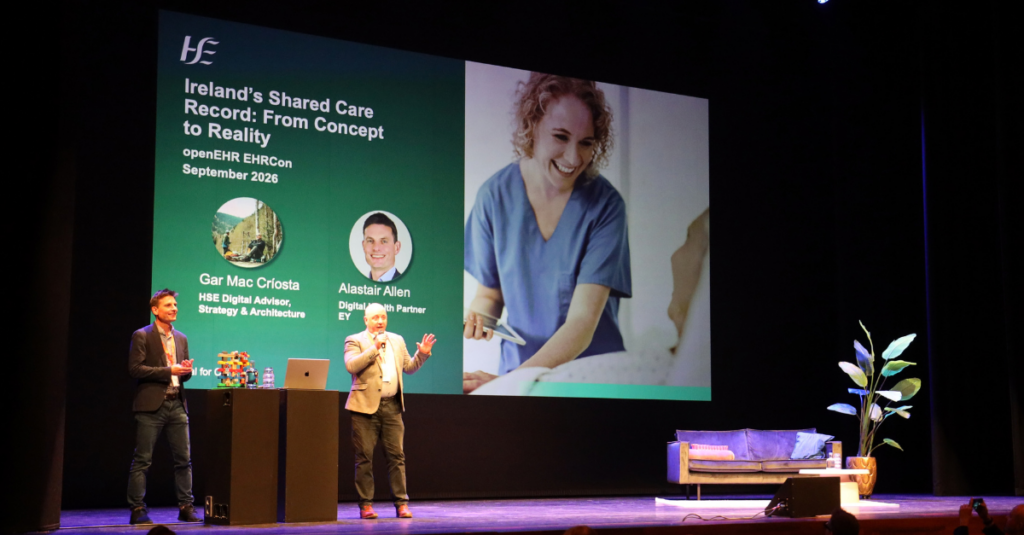
Gar Mac Críosta

Product Manager & Digital Advisor, Health Service Executive, Ireland

Gar Mac Críosta specialises in organisational change, digital transformation, and helping teams succeed in complex, uncertain environments. At Ireland’s HSE, he works at the intersection of strategy, architecture, and product thinking, and he is vocal about the gap between consulting orthodoxy and what actually works. If you want a view from the coalface of national-scale digital health, don’t miss his session.

Professor Rachel Dunscombe

CEO, HL7

Professor Rachel Dunscombe

CEO, HL7

Rachel Dunscombe is one of the few people in this room who has led both openEHR International and a major NHS digital programme — which means she has seen the gap between standards ambition and operational reality from both sides of the fence. As Director of Digital at Salford Royal, she helped build one of the two most digitally mature NHS organisations in the country. She then led openEHR International through a critical period of growth, and is now CEO of HL7, the body behind the FHIR standard that sits alongside openEHR across so much of the global interoperability landscape. Her presence at this conference is a signal about the relationship between these two communities, and what she says about it will be worth listening to carefully.

Davera Gabriel

Director of Client Success, Evidentli

Davera Gabriel

Director of Client Success, Evidentli

Davera Gabriel’s dual fellowship — from the American Medical Informatics Association and from Health Level Seven International — marks her out as someone the informatics establishment has taken seriously for a long time, and with reason. Her expertise sits at the technically demanding intersection of semantic interoperability and terminology standards: the unglamorous but load-bearing work of making sure that when two systems say the same thing, they actually mean the same thing. Her contributions to the National COVID Cohort Collaborative put that expertise to work at a moment when it genuinely mattered. She arrives at this conference as someone who has spent a career trying to make health data mean something consistent — which turns out to be harder than it sounds.

Rix Groenboom

Lecturer New Business & ICT, Hanze University Groningen

Rix Groenboom

Lecturer New Business & ICT, Hanze University Groningen

Rix Groenboom is not a clinician, and he is not a policy person — which is exactly what makes his perspective unusual. He holds a PhD in Computing Science from the University of Groningen, where his thesis tackled the formalisation of domain knowledge: the rigorous, mathematical question of how you represent what a field knows in a form that software can reason about. He then spent years at Parasoft leading strategic innovation in software testing and validation for SOA, SaaS, and cloud architectures. He now leads the New Business and ICT research group at Hanze, where one of his doctoral students is presenting alongside him on DICOM-to-openEHR integration. Groenboom brings a computer scientist’s precision to a domain that sometimes needs it.

Dr Amanda Herbrand

Clinical data specialist

Dr Amanda Herbrand

Clinical data specialist

Amanda Herbrand trained first in physics, then in medicine, and has spent her career trying to get those two modes of thinking to talk to each other productively. Her work sits at the junction of clinical practice and data architecture — designing systems for sustainable clinical data capture that do not simply add burden to the clinician completing them. She is an advocate for the separation of frontend and data logic, the openEHR principle that makes long-term data value possible without locking systems to a single vendor or interface. Her research spans off-label drug use in oncology and the alignment of reimbursement with evidence — two areas where the gap between what data systems capture and what clinical decision-making actually needs is most consequential. She is one of the clearest thinkers in the room on why the architecture of health data is also a clinical ethics question.

Professor David Ingram

Founder, openEHR

Professor David Ingram

Founder, openEHR

There are founding figures, and then there is David Ingram. An honorary member of the Royal College of Physicians of London, a defining voice in health informatics education in the UK, and one of the people without whom this conference — and the standard it is built around — would simply not exist. The website says his contributions to health data science are immeasurable, and for once that is not hyperbole. His presence at EHRCON26 is both a reminder of how far the community has come and a prompt to ask whether it is building on the foundations he laid as well as it should be.

Monica Jones

Chief Data Officer UOL | CEO Animo

Monica Jones

Chief Data Officer UOL | CEO Animo

Monica Jones’s career is essentially a demonstration that deep technical expertise and senior strategic leadership are not mutually exclusive — a proposition the health data sector sometimes struggles to believe. She has operated as both CDO and CIO across major public and private initiatives, with hands-on mastery of SNOMED CT, HL7 FHIR, and OMOP underpinning the strategy rather than sitting beneath it. Through Animo Consultancy she advises organisations including Genomics England and the NHS, moving between enterprise architecture and board-level counsel with apparent ease. She is also, quietly, one of the more important mentors in the UK health informatics community. When Monica talks about making data systems actually work, she is speaking from the experience of having built them.

Henrique Martins

Associate Professor & Digital Consultant

Henrique Martins

Associate Professor & Digital Consultant

Henrique’s CV reads like a deliberate attempt to hold every possible vantage point on digital health simultaneously: medical doctor, internal medicine specialist, PhD in management, near-qualified lawyer studying AI liability, former national eHealth agency president, former co-chair of the EU eHealth Network — the highest policy body on eHealth in the Union. He led Portugal’s national eHealth efforts for close to seven years and drove fast digital transformation as CMIO at Hospital Fernando Fonseca. He now advises, researches, and teaches across three institutions. When he talks about the gap between policy ambition and clinical reality, he is drawing on experience of both sides that very few people can match.

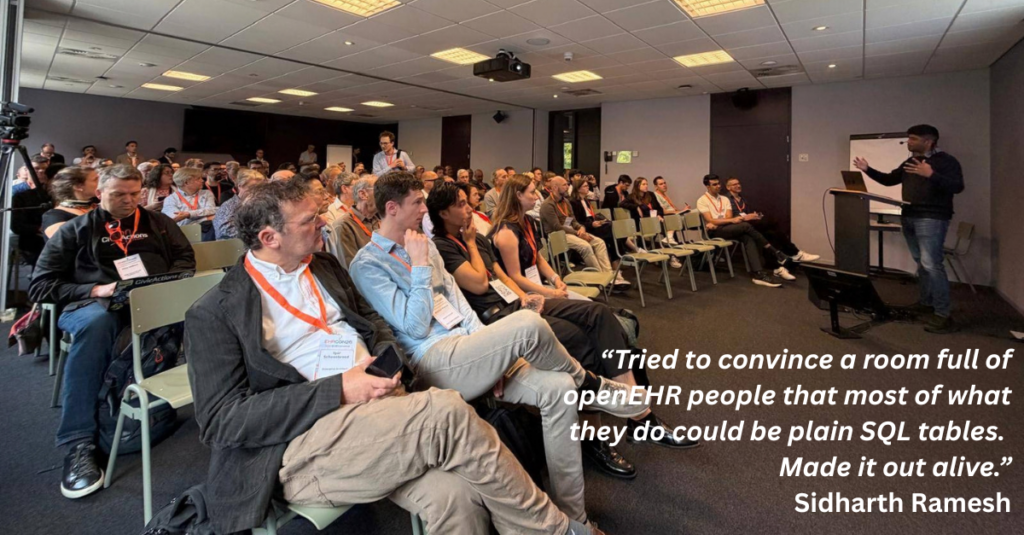
Dr Sidharth Ramesh

CEO, Medblocks

Dr Sidharth Ramesh

CEO, Medblocks

A doctor by training, but a developer at heart — that line from Sidharth’s own bio is the most efficient possible summary of why he matters to this community. He founded Medblocks in 2015 and has built it into one of the most practical, open-source-first forces in the openEHR tooling ecosystem, giving clinicians and developers the components they need to build real applications without starting from scratch. Medblocks UI and Medblocks Stack are in use around the world. Sidharth represents the generation of builders who took the openEHR specification and turned it into something you can actually ship.

Professor Rachel Dunscombe

CEO, HL7

Professor Rachel Dunscombe

CEO, HL7

Rachel Dunscombe is one of the few people in this room who has led both openEHR International and a major NHS digital programme — which means she has seen the gap between standards ambition and operational reality from both sides of the fence. As Director of Digital at Salford Royal, she helped build one of the two most digitally mature NHS organisations in the country. She then led openEHR International through a critical period of growth, and is now CEO of HL7, the body behind the FHIR standard that sits alongside openEHR across so much of the global interoperability landscape. Her presence at this conference is a signal about the relationship between these two communities, and what she says about it will be worth listening to carefully.

Davera Gabriel

Director of Client Success, Evidentli

Davera Gabriel

Director of Client Success, Evidentli

Davera Gabriel’s dual fellowship — from the American Medical Informatics Association and from Health Level Seven International — marks her out as someone the informatics establishment has taken seriously for a long time, and with reason. Her expertise sits at the technically demanding intersection of semantic interoperability and terminology standards: the unglamorous but load-bearing work of making sure that when two systems say the same thing, they actually mean the same thing. Her contributions to the National COVID Cohort Collaborative put that expertise to work at a moment when it genuinely mattered. She arrives at this conference as someone who has spent a career trying to make health data mean something consistent — which turns out to be harder than it sounds.

Rix Groenboom

Lecturer New Business & ICT, Hanze University Groningen

Rix Groenboom

Lecturer New Business & ICT, Hanze University Groningen

Rix Groenboom is not a clinician, and he is not a policy person — which is exactly what makes his perspective unusual. He holds a PhD in Computing Science from the University of Groningen, where his thesis tackled the formalisation of domain knowledge: the rigorous, mathematical question of how you represent what a field knows in a form that software can reason about. He then spent years at Parasoft leading strategic innovation in software testing and validation for SOA, SaaS, and cloud architectures. He now leads the New Business and ICT research group at Hanze, where one of his doctoral students is presenting alongside him on DICOM-to-openEHR integration. Groenboom brings a computer scientist’s precision to a domain that sometimes needs it.

Dr Amanda Herbrand

Clinical data specialist

Dr Amanda Herbrand

Clinical data specialist

Amanda Herbrand trained first in physics, then in medicine, and has spent her career trying to get those two modes of thinking to talk to each other productively. Her work sits at the junction of clinical practice and data architecture — designing systems for sustainable clinical data capture that do not simply add burden to the clinician completing them. She is an advocate for the separation of frontend and data logic, the openEHR principle that makes long-term data value possible without locking systems to a single vendor or interface. Her research spans off-label drug use in oncology and the alignment of reimbursement with evidence — two areas where the gap between what data systems capture and what clinical decision-making actually needs is most consequential. She is one of the clearest thinkers in the room on why the architecture of health data is also a clinical ethics question.

Professor David Ingram

Founder, openEHR

Professor David Ingram

Founder, openEHR

There are founding figures, and then there is David Ingram. An honorary member of the Royal College of Physicians of London, a defining voice in health informatics education in the UK, and one of the people without whom this conference — and the standard it is built around — would simply not exist. The website says his contributions to health data science are immeasurable, and for once that is not hyperbole. His presence at EHRCON26 is both a reminder of how far the community has come and a prompt to ask whether it is building on the foundations he laid as well as it should be.

Monica Jones

Chief Data Officer UOL | CEO Animo

Monica Jones

Chief Data Officer UOL | CEO Animo

Monica Jones’s career is essentially a demonstration that deep technical expertise and senior strategic leadership are not mutually exclusive — a proposition the health data sector sometimes struggles to believe. She has operated as both CDO and CIO across major public and private initiatives, with hands-on mastery of SNOMED CT, HL7 FHIR, and OMOP underpinning the strategy rather than sitting beneath it. Through Animo Consultancy she advises organisations including Genomics England and the NHS, moving between enterprise architecture and board-level counsel with apparent ease. She is also, quietly, one of the more important mentors in the UK health informatics community. When Monica talks about making data systems actually work, she is speaking from the experience of having built them.

Henrique Martins

Associate Professor & Digital Consultant

Henrique Martins

Associate Professor & Digital Consultant

Henrique’s CV reads like a deliberate attempt to hold every possible vantage point on digital health simultaneously: medical doctor, internal medicine specialist, PhD in management, near-qualified lawyer studying AI liability, former national eHealth agency president, former co-chair of the EU eHealth Network — the highest policy body on eHealth in the Union. He led Portugal’s national eHealth efforts for close to seven years and drove fast digital transformation as CMIO at Hospital Fernando Fonseca. He now advises, researches, and teaches across three institutions. When he talks about the gap between policy ambition and clinical reality, he is drawing on experience of both sides that very few people can match.

Dr Sidharth Ramesh

CEO, Medblocks

Dr Sidharth Ramesh

CEO, Medblocks

A doctor by training, but a developer at heart — that line from Sidharth’s own bio is the most efficient possible summary of why he matters to this community. He founded Medblocks in 2015 and has built it into one of the most practical, open-source-first forces in the openEHR tooling ecosystem, giving clinicians and developers the components they need to build real applications without starting from scratch. Medblocks UI and Medblocks Stack are in use around the world. Sidharth represents the generation of builders who took the openEHR specification and turned it into something you can actually ship.


Countries represented in the 2026 programme

Austria · Canada · Estonia · Finland · Germany · Iran · Ireland · Italy · Lithuania · Netherlands · New Zealand · Nigeria · Portugal · Sardinia · Slovenia · Spain · Switzerland · UK · Uruguay · USA

Ones to watch…

These are the talks that caught our programme team’s attention for other reasons.

THE BOLDEST TITLE IN THE PROGRAMME

Stop Building Islands, Start Building Stations: One-Click Federated Health Data with HAIDAL

Pascal Suppers & Igor Schoonbrood  |  Maastricht University / Maastricht UMC+

The Maastricht DataHub team are proposing something genuinely radical: a federated access model where connecting a new hospital repository to a multi-site research query takes a single click. HAIDAL is an operational system, not a whitepaper, and the implications for health research infrastructure are significant.

THE MOST NICHE TITLE THAT TURNED OUT TO MATTER

A DICOM RT DVH caching layer between PACS and clinical data repositories: bridging DICOM and openEHR

Ruben Talstra  |  Hanze University of Applied Sciences, Groningen

Dose-volume histograms in radiotherapy oncology are exactly the kind of domain-specific structured data that openEHR was designed to handle and exactly the kind that falls through every other integration gap. This session addresses a real clinical problem that has remained unsolved for years.

THE NHS VOICE

Making Nursing Data Computable: Towards a Minimum Core International Nursing Data Set

Robylin Tweetie Diya, Chief Nurse Fellow  |  University Hospitals of Leicester NHS Trust

A Chief Nurse Fellow at Leicester who is also completing an MSc in Health Informatics, Diya argues that nursing – the profession closest to most clinical data – has been structurally excluded from health informatics standards work. She builds a practical case for a minimum international nursing data set using openEHR archetypes.

THE GOVERNANCE SESSION (THAT ISN’T BORING)

Clinical Knowledge Management: The Good, the Bad and the Mappings

Dr. Sebastian Garde  |  Ocean Health Systems

Dr Garde has spent longer than most working in the CKM trenches, and his session promises to be candid about what works, what doesn’t, and why mappings between clinical models are harder than they seem. The promise of openEHR rests heavily on good knowledge governance; this session balances honestly with the gap.

EHRCON25 Schedule
Monday, September 21
18:00 – 20:00
Pre-conference mixer
Join us for networking before the main event. First drink free, courtesy ofvitagroup Logo
Tuesday, September 22
8:00 – 9:00
Registration
Collect your badge and EHRCON25 goodie bag
Foyer
9:00 – 9:40
Welcome & 10 achievements for openEHR in the past year
Red Room
9:40 – 10:05
Keynote: AI: the agentic future
Red Room
10:05 – 10:25
Keynote: Identifying top global growth opportunities for openEHR adoption in 2025 and beyond
Red Room
10:25 – 10:30
The ePatient perspective (video)
Red Room
10:30 – 11:00
Refreshments
with thanks to our sponsor Medblocks Logo
Foyer
11:00 – 12:30 | Breakout Sessions
Red Room: The AI landscape
11:00 – 11:25
11:25 – 11:50
11:50 – 12:30
Meeting Room 1: European session
11:00 – 11:20
11:20 – 11:40
11:40 – 12:00
12:00 – 12:20
Meeting Room 2: Quick-fire clinical
11:00 – 11:20
11:20 – 11:40
11:40 – 12:00
12:00 – 12:20
12:30 – 13:30
Lunch
courtesy of our sponsor vitagroup Logo
Lunchtime sessions – Meeting Room 1
Discourse drop-in session
Pitchfest: explaining openEHR
13:30 – 15:00 | Breakout Sessions
Red Room: Digital frontiers
13:30 – 13:45
13:45 – 14:30
14:30 – 15:00
Meeting Room 1: Innovation
13:30 – 13:45
13:45 – 14:00
14:00 – 14:15
14:15 – 15:00
Meeting Room 2: Population health
13:30 – 13:50
13:50 – 14:05
14:05 – 14:35
14:35 – 15:00
15:00 – 15:30
Refreshments
with thanks to our sponsor Ocean Logo
Foyer
15:30 – 15:55
Open health data platforms and AI
Red Room
15:55 – 16:20
Transforming healthcare delivery: where openEHR and AI co-operate
Red Room
16:20 – 16:40
Keynote: AI & cognitive science: where the magic happens
Red Room
16:40 – 17:00
The David Ingram Award & Summary of Day 1
Red Room
19:00 – 02:00
Evening meal, wine and entertainment
courtesy of our sponsor Better Logo
Cal Pinxo restaurant
Wednesday, September 23
9:00 – 9:10
Recap of Day 1
Red Room
9:10 – 9:40
Keynote: The future of standards
Red Room
9:40 – 10:05
Keynote: Sparked AU: community and collaboration as the driving force for change
Red Room
10:05 – 10:30
Data4Life strategy from Hospital Universitario 12 de Octubre
Red Room
10:30 – 11:00
Refreshments
with thanks to our sponsor Tietoevry Logo
Foyer
11:00 – 12:30 | Breakout Sessions
Red Room: Practical applications
11:00 – 11:30
11:30 – 12:00
12:00 – 12:30
Meeting Room 1: Spotlight
11:00 – 12:00
12:00 – 12:30
Meeting Room 2: Real-world solutions
11:00 – 11:30
11:30 – 12:00
12:00 – 12:30
12:45 – 13:30
Lunch
courtesy of our sponsor vitagroup Logo
Lunchtime session – Meeting Room 1
Things left outstanding: Extracts, IPS, and CKM Models: navigating alignment and data sovereignty nationally and internationally
13:30 – 15:00 | Breakout Sessions
Red Room: New horizons
13:30 – 14:00
14:00 – 14:30
14:30 – 15:00
Meeting Room 1: Tech session
13:30 – 13:50
13:50 – 14:10
14:10 – 14:30
14:30 – 14:50
Meeting Room 2: Co-design
13:30 – 13:50
13:50 – 14:10
14:10 – 14:30
14:30 – 14:50
15:00 – 15:30
Refreshments
with thanks to our sponsor CSIRO Logo
Foyer
15:30 – 15:35
OHDSI/Vocabularies
Red Room
15:35 – 16:20
Panel: The future of standards (open and community)
Red Room
16:20 – 16:30
Closing remarks
Red Room
openehr.org