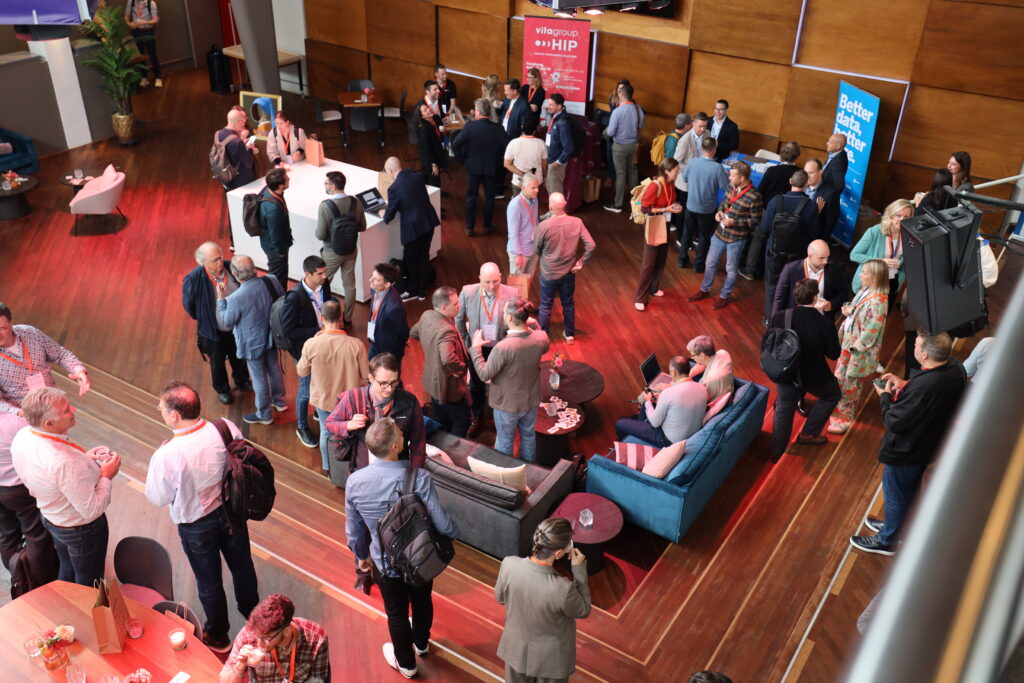
Join us for networking before the main event. First drink free, courtesy of
Venue TBC
Tuesday, September 22 ▼
07:30 – 08:30
Registration
Collect your badge and EHRCON26 goodie bag
Foyer
08:30 – 08:50
Welcome
Dr. Jordi Piera Jiménez (openEHR International CEO) • Tomaž Gornik (openEHR International Chair) • Wouter Zanen (openEHR Netherlands) • Herko Coomans (SNOMED)
Plenary (Red Hall)
08:50 – 09:00
Call to Action: Educational Partners
Rix Groenboom (Hanze University of Applied Sciences)
Plenary (Red Hall)
09:00 – 09:30
Keynote
Herko Coomans (SNOMED)
Plenary (Red Hall)
09:30 – 09:45
OECD Report
Rachel Fellner (OECD)
Plenary (Red Hall)
09:45 – 10:15
Keynote
Walter Kraan (Nictiz)
Plenary (Red Hall)
10:15 – 10:45
Refreshments
with thanks to our sponsor
Foyer
10:45 – 12:15 | Breakout Sessions
Plenary (Red Hall): EHDS
Room 1: Education
Room 2: openEHR 101
Room 3: Compliance & Conformance
10:45
10:45 – 11:05
Keynote
Konstantin Hyppönen (DG SANTE)
10:45 – 11:00
Education enabling openEHR success
Hanna Pohjonen (Rosaldo / openEHR EPB) & David Moner Cano (Veratech / openEHR EPB)
11:00 – 12:15
Presentation of abstracts/posters from EHRCON26 Conference proceedings
with thanks to our sponsor
Presentations of openEHR Fellowship Projects from Cohort 1: 2025-26
Details TBC
10:45 – 12:15
Presentations
Starting with openEHR as a Healthcare Organisation: A Practical Guide – Martin van de Meer (CODE24)
Introduction to Modelling – Martin Koch (CatSalut)
Moving Healthcare Data with the Care Demand – RSO Zuid Limburg – Remko Nienhuis & Wim Eurlings
Catalonia Story – Laura Moral (CatSalut)
What Makes Health Data Truly Interoperable? The Patient-in-the-Loop Data Concept – John Kildea (McGill University)
10:45 – 11:05
Conformance Testing openEHR with FHIR
Marc van Aalten & Jorn Duwell (Interoplab)
11:05 – 11:25
openEHR and the Enigma
Eric Browne (Montage Systems)
11:25 – 11:45
Everyone Agrees the Boundary Is Lossy. Nobody Owns the Loss
Davera Gabriel (Evidentli)
11:45 – 12:15
Measuring Collaboration
Cindy Throop (Open Health Research Institute)
11:05
11:05 – 11:25
Presentation
Robert Stegwee (ESHIA)
11:25
11:25 – 11:45
Presentation
Dr Nils Hellrung (vitagroup)
11:45
11:45 – 12:15
Panel Discussion
Facilitated by Luis Marco Ruiz (vitagroup) • Henrique Martins (ISCTE – Instituto Universitário de Lisboa) • Robert Stegwee (ESHIA) • Ian McNicoll (freshEHR / openEHR) • Wouter Zanen (Nictiz) • Konstantin Hyppönen (DG SANTE)
12:15 – 13:30
Lunch
courtesy of our sponsor
13:30 – 15:00 | Breakout Sessions
Plenary (Red Hall): openEHR
Room 1: EHDS (cont’d)
Room 2: openEHR in the Wild 101
Room 3: Research & Innovation
13:30
13:30 – 13:50
The Trust Stack: QUANTUM Data Quality Label, openEHR, and the Rise of EHDS-Ready Data
Monica Jones (Animo Consultancy)
13:30 – 15:00
International Deployments
From Fragmentation to Sustainability: Asia’s Journey to Scalable Health Interoperability with openEHR – Kathir Kathiresan (Ezovion)
Bringing Functionality to Data: University Hospital Basel’s openEHR Journey – Maren Diepenbruck (University Hospital Basel)
openEHR goes DACH – Amanda Herbrand (xtention)
Building a National EHR in Iran: An 18-Year Journey – Somayeh Abedian
Lithuania’s Journey from National openEHR Proof of Concept to Hospital Adoption – Antanas Montvila (Hospital of Lithuanian University of Health Sciences)
From Fragmented Parenting Work to Sustainable Digital Care – Marju Eeriku (PAM – Parental Assistant in Medicine)
Nurse Citizen Developers: Building the Open Nursing Core for a Data-Driven Future – Lincoln Gombedza & Kumbi Kariwo (North Staffordshire Combined Healthcare NHS Trust)
Building Multidisciplinary Clinical Knowledge Modelling Teams from Scratch – Martin Koch, David Hernandez Rodriguez & Laura Moral (CatSalut)
Koray Atalag (Galata Digital) & Dr John Powderly (Carolina Institute of Oncology & BioCytics Inc)
13:30 – 13:45
Results of Survey
Severin Kohler (Charité)
13:45 – 14:30
Reports from the openEHR Program Boards (SPB, CPB, SEC, EPB, APB)
13:50 – 14:10
EHDS in Clinical Practice
Mika Kiviaho (Tieto Caretech)
14:10 – 14:30
Operationalising Citizen Data Access in a Decentralised Healthcare System: The Dutch MedMij Framework
Margo Brands (Stichting MedMij)
14:30
14:30 – 14:50
Keynote and Presentation of The David Ingram Award
David Ingram (openEHR Foundation Board)
14:30 – 14:45
EHDS-Ready by Design: How openEHR Enables the European Health Data Space
Samo Drnovšek (Better)
14:45 – 15:00
From HCIMs to Generic Building Blocks: Aligning National Interoperability with EHDS
Malou Paiman & Wouter Zanen (Nictiz)
14:30 – 14:40
One Patient, One Record: Building a Semantic MPI on openEHR DEMOGRAPHIC Archetypes
Pablo Pazos (Cabolabs)
14:40 – 14:50
Strong Together for Tomorrow’s Healthcare
Teemu Vähäkainu (Tieto Caretech)
14:50 – 15:00
From Interoperability to Innovation: What Makes an openEHR Ecosystem Innovation-Ready?
Yana Yoncheva (Basel Area Business & Innovation)
14:50
14:50 – 15:00
Fellowship Awards
Somayeh Abedian (Ludwig Boltzmann Institute) • Ian Bennet (Better) • Martin Koch (CatSalut) • Xabier Michelena Vegas (CatSalut) • Dr Osama El Hassan • Nicola Hall (Ministry of Health & Wellness, Jamaica) • Dr Lars Fuhrmann (German Society of Ophthalmology)
15:00 – 15:30
Refreshments
with thanks to our sponsor
Foyer
15:30 – 16:00
Better Data, Better Insights, Better Outcomes
Myriam Fernández Martín, PhD (AWS)
Plenary (Red Hall)
16:00 – 16:30
Catalonia’s Open Platform
Dr Xabier Michelena Vegas (CatSalut) & Jesús Pulgarín Paños (NTT Data)
Plenary (Red Hall)
16:30 – 16:50
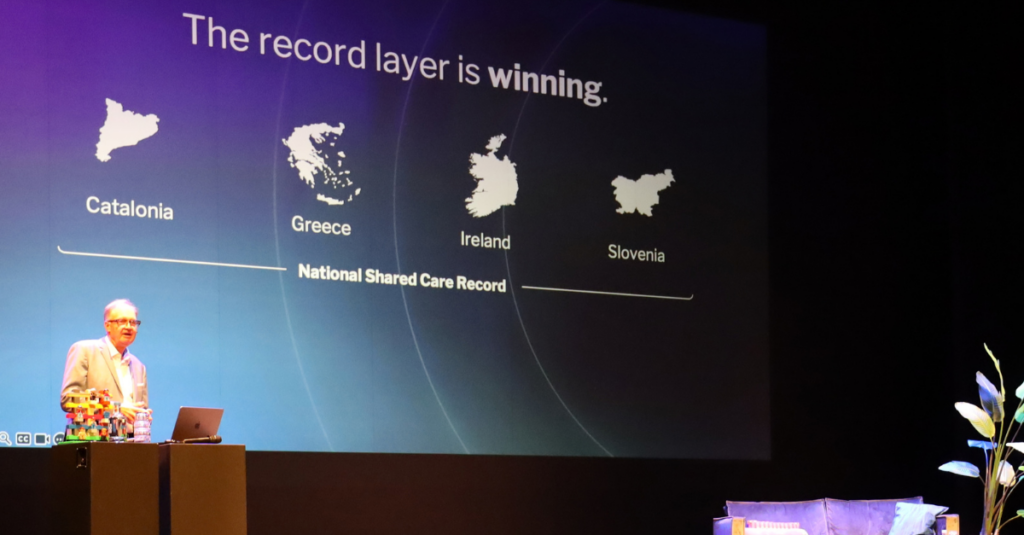
Coordinating care at a national level: the case of Slovenia
Katarina Kralj (Slovenian Ministry of Health)
Plenary (Red Hall)
16:50 – 17:40
Panel: Policy and Governance
Details TBC
Plenary (Red Hall)
17:40 – 18:00
Day 1 Round-up
Dr. Jordi Piera Jiménez (openEHR)
Plenary (Red Hall)
18:00 – 02:00
Drinks reception, dinner and entertainment
courtesy of our sponsor
Blue Hall
Wednesday, September 23 ▼
08:30 – 08:40
Welcome & Day 1 Recap
Plenary (Red Hall)
08:40 – 09:10
Keynote
Aloha McBride (U.S. Department of Veterans Affairs)
Plenary (Red Hall)
09:10 – 09:35
Keynote: Health at Our Fingertips: How the EUDI Wallet – EHDS Digital Twin Ecosystem is Transforming Healthcare
Zoltan Lantos (Department of Health, Ireland)
Plenary (Red Hall)
09:35 – 09:55
Keynote
Tomaž Gornik (Better)
Plenary (Red Hall)
09:55 – 10:30
Panel: Next-Generation EHR
Facilitated by Tomaž Gornik (Better) • Catalonia rep • Patrik Georgii-Hemming (Karolinska University Hospital) • Stefan Becker (Schwarz Charité Health Data) • Margo Brands (Stichting MedMij) • Marc van Aalten (Interoplab) • Teemu Vähäkainu (Tieto Caretech)
Plenary (Red Hall)
10:30 – 11:00
Refreshments
with thanks to our sponsor
Foyer
11:00 – 12:00 | Breakout Sessions
Plenary (Red Hall): Clinical
Room 1: openEHR Affiliates & Marketing
Room 2: Research
11:00
11:00 – 11:30
The Forgotten Foundation: Clinicians, Coordination, and the Future of Care
Dr Mehdi Khaled (SEHA)
11:00 – 11:30
What Can Your Affiliate Do for You?
Wouter Zanen (Nictiz)
11:00 – 11:30
Clinical Knowledge Management: The Good, the Bad and the Mappings
Dr Sebastian Garde (Ocean Health Systems)
11:30
11:30 – 11:50
Untapped Potential in Specialist Clinical Domains – Progress and Collaborations in Eye Care
Dr Lars Fuhrmann (German Society of Ophthalmology) & Co-speaker (UK Royal College of Ophthalmology / openEyes)
11:30 – 12:00
Marketing and Stakeholder Management
Facilitated by Lukas Eksteen (Ocean Health Systems) • Brina Tomovič Kandare (Better) • Maja Dragovic (vitagroup) • Jenny Luco (Cadasto) • Peter Bouvier (openEHR)
11:30 – 12:00
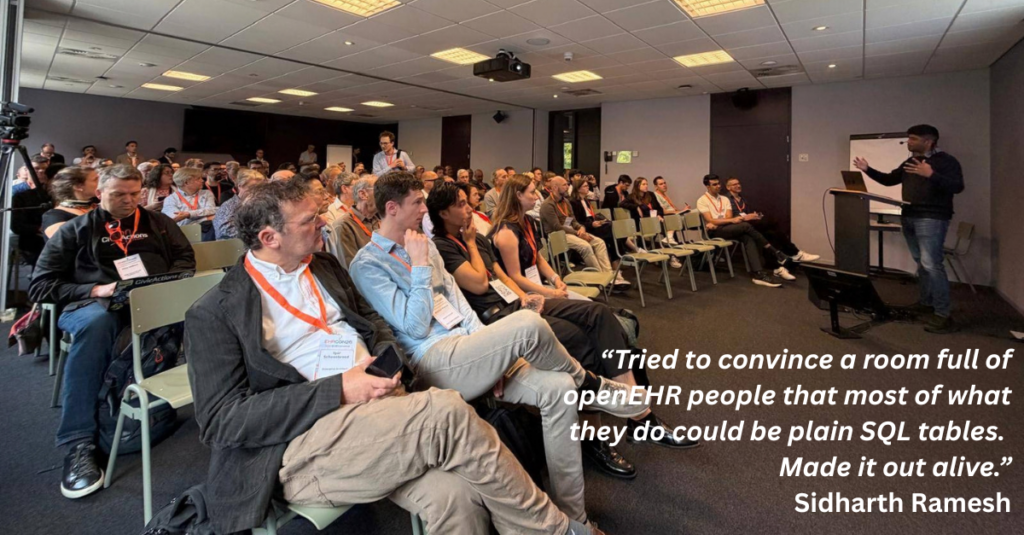
openEHR Archetypes as Dimensional SQL Models
Dr Sidharth Ramesh (Medblocks)
11:50
11:50 – 12:00
openOutcomes
Kanthan Theivendran
12:00 – 13:15
Lunch
with thanks to our sponsor
13:15 – 15:15 | Breakout Sessions
Plenary (Red Hall): Interoperability
Room 1: Agentic AI
Room 2: Modelling (cont’d)
13:15
13:35
13:55
14:15
14:35
13:15 – 13:35
Scaling the EHDS with an openEHR/FHIR Co-Modelling Platform – and a Realistic AI Strategy
Seref Arikan (Ocean Informatics)
13:35 – 13:55
How openEHR Fits in a Landscape of Dutch Use Cases and Generic Functions
Gasper Andrejc (Syntaric)
13:55 – 14:15
Mapping openEHR and OMOP: Updates on the OHDSI OMOP-openEHR Working Group
Diego Boscá Tomás (Veratech) • Somayeh Abedian (Ludwig Boltzmann Institute for Digital Health and Prevention) • Severin Kohler (Berlin Institute of Health in der Charité)
14:15 – 14:35
Accelerating EHDS Readiness: Advancing openEHR and FHIR Alignment for European Interoperability
Data Standardization in Audiology: Insights from the Cluster of Excellence “Hearing4all.connects”
Lena Schell-Majoor (Carl von Ossietzky Universität)
14:35 – 15:15
Stop Building Islands, Start Building Stations: One-Click Federated Health Data with HAIDAL
Pascal Suppers & Igor Schoonbrood (Maastricht UMC+)
15:15 – 15:45
Refreshments
with thanks to our sponsor
Foyer
15:45 – 16:05
Sovereign Health Data Integration in European Medicine: Insights from the Schwarz Charité Health Data Platform
Stefan Becker & Mathias Groschl (Schwarz Charité Health Data GmbH)
Plenary (Red Hall)
16:05 – 16:25
DPI for Health
Chinemerem Chika (WHO)
Plenary (Red Hall)
16:25 – 17:00
Panel: What’s Next?
Herko Coomans (SNOMED) • Walter Kraan (Nictiz) • Konstantin Hyppönen (DG SANTE) • Gar Mac Criosta (Health Service Executive Ireland) • Chinemerem Chika (WHO) • Moderated by Dr. Jordi Piera Jiménez (openEHR)
Over fifty presentations. Speakers from more than twenty countries. Government ministers, national health system clinicians, founding figures of the openEHR standard, major EHR vendors, university research centres, and a startup building AI-powered care records in Nigeria. EHRCON26 is set to be our boldest, biggest, broadest and most international yet - and below is our pick of the sessions you will not want to miss.
Open to conference attendees only, this hands-on, practitioner-oriented workshop will focus on archetype and template design - the clinical modelling skills that underpin every openEHR implementation. Building on the successful CPB workshop format from EHRCON25 (Barcelona), this session goes deeper with guided exercises, use cases and practical guidance from industry experts.
Who should come:
Practitioners and implementers with intermediate-level openEHR experience
Clinical informaticians wanting to improve their modelling skills
An openEHR-accredited certificate of Proficiency in Clinical Modelling
N.B. If you want to attend this workshop, please ensure you select the 'Modelling Workshop (21 Sept) + Full Conference Pass (22 & 23 Sept)' option when you purchase your ticket.
EHRCON26
Tuesday 22 and Wednesday 23 September 2026
Our standard two-day conference package includes entry to all sessions on 22 and 23 September, refreshments and lunch on both days, and conference dinner and entertainment on the evening of Tuesday 22 September. For anyone arriving in Amsterdam the night before, you're welcome to join us for pre-conference drinks on the evening of Monday 21 September (venue TBC). Watch this space for more information.
Alongside our more advanced technical streams, this year’s conference includes beginner-friendly sessions that introduce the fundamentals of openEHR and explore how it can support digital health initiatives in your organisation.
BIG names
KEYNOTE - THE FUTURE OF OPENEHR
Dr Jordi Piera Jiménez
CEO, openEHR International
Jordi is our new CEO, and his arrival has signaled a new chapter for openEHR. He brings over 25 years at the sharp end of digital health, having led some of the most ambitious health system transformation programmes in Europe from his home in Catalonia. He has worked with the WHO, the OECD, and shaped policy at the European Health Data Space level. A technologist, strategist, and community builder: we expect him to set out a compelling vision for where openEHR goes next.
Aloha McBride
Global Health Executive
Aloha McBride is a global health executive, board director, and transformational leader with a proven track record of driving growth, innovation, and business transformation across the healthcare sector. She has built and led industry-leading consulting practices, managed complex global engagements, and advised senior leaders across healthcare providers, payers, government agencies, NGOs, and military organizations. Combining deep international experience with Big Four consulting expertise, Aloha specializes in digital health, AI-enabled transformation, health system strengthening, and strategic partnerships. Known for connecting diverse stakeholders and delivering measurable outcomes, she helps organizations navigate change, accelerate innovation, and create sustainable value at scale.
KEYNOTE - NATIONAL SCALE
KEYNOTE - INDUSTRY
Walter Kraan
Product Development Manager, Nictiz
Walter Kraan is a business-oriented digital transformation leader with more than 25 years of experience in strategy, information management, and programme delivery - and crucially, he comes from outside healthcare. His background spans financial services, telecoms, and government, which means he brings a rigour and scepticism to digitalisation that the sector badly needs: the insistence that technology follows process, not the other way round. At Nictiz, the Netherlands' national institute for health IT standardisation, he is applying that discipline to some of Europe's most consequential interoperability work.
Herko Coomans
Vice Chair, SNOMED International; Dutch Ministry of Health
Herko Coomans is a HIMSS Future50 Government Leader and one of the most influential civil servants in European digital health: a Dutch Ministry of Health insider who has spent years making sure health information actually crosses borders rather than just theoretically being allowed to. As Vice Chair of SNOMED International and a driving force behind the Global Digital Health Partnership, Herko sits at the junction of standards, policy, and international cooperation.
KEYNOTE - INTEROPERABILITY
KEYNOTE - DIGITAL TRANSFORMATION
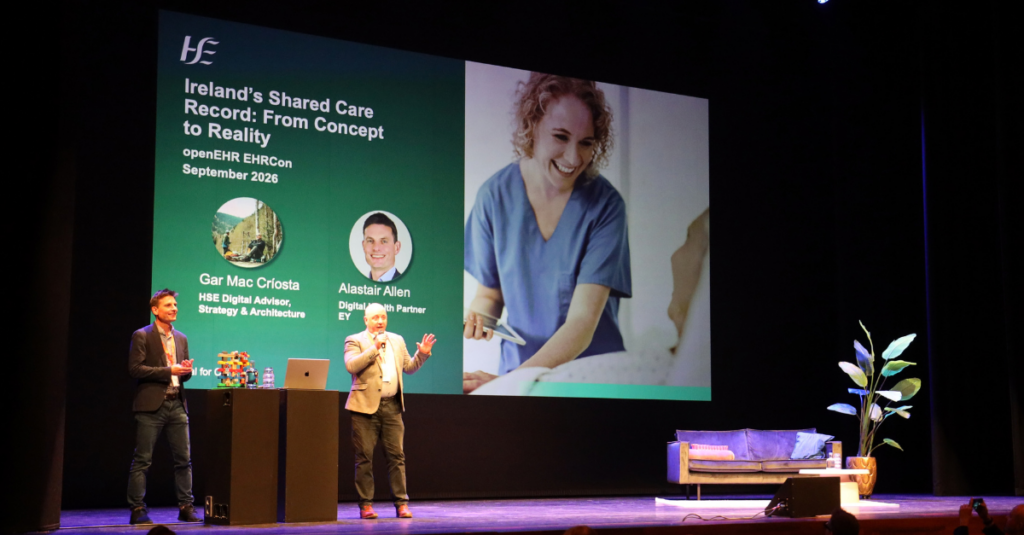
Gar Mac Críosta
Product Manager & Digital Advisor, Health Service Executive, Ireland
Gar Mac Críosta specialises in organisational change, digital transformation, and helping teams succeed in complex, uncertain environments. At Ireland's HSE, he works at the intersection of strategy, architecture, and product thinking, and he is vocal about the gap between consulting orthodoxy and what actually works. If you want a view from the coalface of national-scale digital health, don't miss his session.
KEYNOTE - GOVERNMENT
Katarina Kralj
Acting Director-General, Digitalisation in Healthcare / Ministry of Health, Slovenia
Slovenia does not make a lot of noise about what it has built — which is exactly why this session is worth attending. Katarina oversees a national eHealth programme that has assembled one of the most coherent openEHR-based health data architectures in Europe, including a central openEHR repository, a working FHIR gateway, and genuine clinical adoption. She will walk us through how a small country moves faster than larger ones when the governance is right.
Dr Mehdi Khaled
Fortune 50 Health & Tech Executive
Mehdi Khaled has spent thirty years doing the thing the industry most needs and rewards least: making clinical expertise legible to technologists, and technology legible to clinicians. He has worked with T-Systems, SAP and Oracle - where he served as Global Chief Medical Officer - and now advises health ministries on national digital transformation through SEHA, the consultancy he founded. His keynote, The Forgotten Foundation: Clinicians, Coordination, and the Future of Care, argues that the distance between a shared record and a shared care plan is not technical, but clinical. Nearly one in three European adults lives with multiple chronic conditions; together they account for 80% of EU healthcare spending; most receive care that is fragmented and blind to the whole person. openEHR's promise, Khaled contends, is interdisciplinary care by design.
KEYNOTE - CARE COORDINATION
KEYNOTE - POLICY
Robert Stegwee
Chair, CEN/TC 251
Robert Stegwee's career spans decades of shaping how technology and healthcare systems align, and as Chair of CEN/TC 251 - the European committee for health informatics standards - he is one of the most important people in the room for anyone working on EHDS compliance, cross-border record exchange, or the regulatory future of health data in Europe. He brings both HL7 and CEN expertise, which means he sees the full landscape of the standards ecosystem rather than advocating for a single corner of it. His perspective on where openEHR sits in that broader architecture is one we're particularly keen to hear.
Rix Groenboom
Lecturer New Business & ICT, Hanze University Groningen
Rix Groenboom
Lecturer New Business & ICT, Hanze University Groningen
Rix Groenboom is not a clinician, and he is not a policy person — which is exactly what makes his perspective unusual. He holds a PhD in Computing Science from the University of Groningen, where his thesis tackled the formalisation of domain knowledge: the rigorous, mathematical question of how you represent what a field knows in a form that software can reason about. He then spent years at Parasoft leading strategic innovation in software testing and validation for SOA, SaaS, and cloud architectures. He now leads the New Business and ICT research group at Hanze, where one of his doctoral students is presenting alongside him on DICOM-to-openEHR integration. Groenboom brings a computer scientist's precision to a domain that sometimes needs it.
Dr Amanda Herbrand
Clinical data specialist
Dr Amanda Herbrand
Clinical data specialist
Amanda Herbrand trained first in physics, then in medicine, and has spent her career trying to get those two modes of thinking to talk to each other productively. Her work sits at the junction of clinical practice and data architecture — designing systems for sustainable clinical data capture that do not simply add burden to the clinician completing them. She is an advocate for the separation of frontend and data logic, the openEHR principle that makes long-term data value possible without locking systems to a single vendor or interface. Her research spans off-label drug use in oncology and the alignment of reimbursement with evidence — two areas where the gap between what data systems capture and what clinical decision-making actually needs is most consequential. She is one of the clearest thinkers in the room on why the architecture of health data is also a clinical ethics question.
Dr Konstantin Hyppönen
Policy Officer, European Commission
Dr Konstantin Hyppönen
Policy Officer, European Commission
Dr. Konstantin Hyppönen is a policy officer working on digital health in DG SANTE of the European Commission. He is currently participating in work on the European Health Data Space. Previously, he has taken part in a number of international projects, including setting up the EU Digital COVID Certificate system, and cross-border ePrescription and Patient Summary services between EU Member States (MyHealth@EU). He currently acts as a policy owner of MyHealth@EU, working on the expansion of this infrastructure. Before joining the Commission, in Finland, Dr. Hyppönen had worked as a chief architect in Kela's Information Services, responsible for the technical architecture of the Finnish eHealth and social services hub, Kanta Services.
Dr Zoltan Lantos
Head of Department of Virtual Health Guide Methodology, Semmelweis University Faculty of Health Sciences
Dr Zoltan Lantos
Head of Department of Virtual Health Guide Methodology, Semmelweis University Faculty of Health Sciences
Zoltán Lantos, Ph.D., is a researcher, entrepreneur, and healthcare innovator focused on building human-centred health ecosystems through technology, behavioural science, and social innovation. He serves as Head of the Department of Virtual Health Guide Methodology at Semmelweis University, Managing Director and founder of Jill Health Guide Holding ApS, and Head of Research at eHealth Software Solutions Ltd. With expertise spanning immunology, behavioural economics, and art therapy, he has pioneered healthcare programmes, digital health solutions, and personalised care models. His current work explores AI-driven virtual health assistants, personalised medicine, and the human values shaping healthcare in the age of automation.
Professor David Ingram
Founder, openEHR
Professor David Ingram
Founder, openEHR
There are founding figures, and then there is David Ingram. An honorary member of the Royal College of Physicians of London, a defining voice in health informatics education in the UK, and one of the people without whom this conference — and the standard it is built around — would simply not exist. The website says his contributions to health data science are immeasurable, and for once that is not hyperbole. His presence at EHRCON26 is both a reminder of how far the community has come and a prompt to ask whether it is building on the foundations he laid as well as it should be.
Monica Jones
Chief Data Officer UOL | CEO Animo
Monica Jones
Chief Data Officer UOL | CEO Animo
Monica Jones's career is essentially a demonstration that deep technical expertise and senior strategic leadership are not mutually exclusive — a proposition the health data sector sometimes struggles to believe. She has operated as both CDO and CIO across major public and private initiatives, with hands-on mastery of SNOMED CT, HL7 FHIR, and OMOP underpinning the strategy rather than sitting beneath it. Through Animo Consultancy she advises organisations including Genomics England and the NHS, moving between enterprise architecture and board-level counsel with apparent ease. She is also, quietly, one of the more important mentors in the UK health informatics community. When Monica talks about making data systems actually work, she is speaking from the experience of having built them.
Henrique Martins
Associate Professor & Digital Consultant
Henrique Martins
Associate Professor & Digital Consultant
Henrique's CV reads like a deliberate attempt to hold every possible vantage point on digital health simultaneously: medical doctor, internal medicine specialist, PhD in management, near-qualified lawyer studying AI liability, former national eHealth agency president, former co-chair of the EU eHealth Network — the highest policy body on eHealth in the Union. He led Portugal's national eHealth efforts for close to seven years and drove fast digital transformation as CMIO at Hospital Fernando Fonseca. He now advises, researches, and teaches across three institutions. When he talks about the gap between policy ambition and clinical reality, he is drawing on experience of both sides that very few people can match.
Dr Sidharth Ramesh
CEO, Medblocks
Dr Sidharth Ramesh
CEO, Medblocks
A doctor by training, but a developer at heart — that line from Sidharth's own bio is the most efficient possible summary of why he matters to this community. He founded Medblocks in 2015 and has built it into one of the most practical, open-source-first forces in the openEHR tooling ecosystem, giving clinicians and developers the components they need to build real applications without starting from scratch. Medblocks UI and Medblocks Stack are in use around the world. Sidharth represents the generation of builders who took the openEHR specification and turned it into something you can actually ship.
Rix Groenboom
Lecturer New Business & ICT, Hanze University Groningen
Rix Groenboom
Lecturer New Business & ICT, Hanze University Groningen
Rix Groenboom is not a clinician, and he is not a policy person — which is exactly what makes his perspective unusual. He holds a PhD in Computing Science from the University of Groningen, where his thesis tackled the formalisation of domain knowledge: the rigorous, mathematical question of how you represent what a field knows in a form that software can reason about. He then spent years at Parasoft leading strategic innovation in software testing and validation for SOA, SaaS, and cloud architectures. He now leads the New Business and ICT research group at Hanze, where one of his doctoral students is presenting alongside him on DICOM-to-openEHR integration. Groenboom brings a computer scientist's precision to a domain that sometimes needs it.
Dr Amanda Herbrand
Clinical data specialist
Dr Amanda Herbrand
Clinical data specialist
Amanda Herbrand trained first in physics, then in medicine, and has spent her career trying to get those two modes of thinking to talk to each other productively. Her work sits at the junction of clinical practice and data architecture — designing systems for sustainable clinical data capture that do not simply add burden to the clinician completing them. She is an advocate for the separation of frontend and data logic, the openEHR principle that makes long-term data value possible without locking systems to a single vendor or interface. Her research spans off-label drug use in oncology and the alignment of reimbursement with evidence — two areas where the gap between what data systems capture and what clinical decision-making actually needs is most consequential. She is one of the clearest thinkers in the room on why the architecture of health data is also a clinical ethics question.
Dr Konstantin Hyppönen
Policy Officer, European Commission
Dr Konstantin Hyppönen
Policy Officer, European Commission
Dr. Konstantin Hyppönen is a policy officer working on digital health in DG SANTE of the European Commission. He is currently participating in work on the European Health Data Space. Previously, he has taken part in a number of international projects, including setting up the EU Digital COVID Certificate system, and cross-border ePrescription and Patient Summary services between EU Member States (MyHealth@EU). He currently acts as a policy owner of MyHealth@EU, working on the expansion of this infrastructure. Before joining the Commission, in Finland, Dr. Hyppönen had worked as a chief architect in Kela's Information Services, responsible for the technical architecture of the Finnish eHealth and social services hub, Kanta Services.
Dr Zoltan Lantos
Head of Department of Virtual Health Guide Methodology, Semmelweis University Faculty of Health Sciences
Dr Zoltan Lantos
Head of Department of Virtual Health Guide Methodology, Semmelweis University Faculty of Health Sciences
Zoltán Lantos, Ph.D., is a researcher, entrepreneur, and healthcare innovator focused on building human-centred health ecosystems through technology, behavioural science, and social innovation. He serves as Head of the Department of Virtual Health Guide Methodology at Semmelweis University, Managing Director and founder of Jill Health Guide Holding ApS, and Head of Research at eHealth Software Solutions Ltd. With expertise spanning immunology, behavioural economics, and art therapy, he has pioneered healthcare programmes, digital health solutions, and personalised care models. His current work explores AI-driven virtual health assistants, personalised medicine, and the human values shaping healthcare in the age of automation.
Professor David Ingram
Founder, openEHR
Professor David Ingram
Founder, openEHR
There are founding figures, and then there is David Ingram. An honorary member of the Royal College of Physicians of London, a defining voice in health informatics education in the UK, and one of the people without whom this conference — and the standard it is built around — would simply not exist. The website says his contributions to health data science are immeasurable, and for once that is not hyperbole. His presence at EHRCON26 is both a reminder of how far the community has come and a prompt to ask whether it is building on the foundations he laid as well as it should be.
Monica Jones
Chief Data Officer UOL | CEO Animo
Monica Jones
Chief Data Officer UOL | CEO Animo
Monica Jones's career is essentially a demonstration that deep technical expertise and senior strategic leadership are not mutually exclusive — a proposition the health data sector sometimes struggles to believe. She has operated as both CDO and CIO across major public and private initiatives, with hands-on mastery of SNOMED CT, HL7 FHIR, and OMOP underpinning the strategy rather than sitting beneath it. Through Animo Consultancy she advises organisations including Genomics England and the NHS, moving between enterprise architecture and board-level counsel with apparent ease. She is also, quietly, one of the more important mentors in the UK health informatics community. When Monica talks about making data systems actually work, she is speaking from the experience of having built them.
Henrique Martins
Associate Professor & Digital Consultant
Henrique Martins
Associate Professor & Digital Consultant
Henrique's CV reads like a deliberate attempt to hold every possible vantage point on digital health simultaneously: medical doctor, internal medicine specialist, PhD in management, near-qualified lawyer studying AI liability, former national eHealth agency president, former co-chair of the EU eHealth Network — the highest policy body on eHealth in the Union. He led Portugal's national eHealth efforts for close to seven years and drove fast digital transformation as CMIO at Hospital Fernando Fonseca. He now advises, researches, and teaches across three institutions. When he talks about the gap between policy ambition and clinical reality, he is drawing on experience of both sides that very few people can match.
Dr Sidharth Ramesh
CEO, Medblocks
Dr Sidharth Ramesh
CEO, Medblocks
A doctor by training, but a developer at heart — that line from Sidharth's own bio is the most efficient possible summary of why he matters to this community. He founded Medblocks in 2015 and has built it into one of the most practical, open-source-first forces in the openEHR tooling ecosystem, giving clinicians and developers the components they need to build real applications without starting from scratch. Medblocks UI and Medblocks Stack are in use around the world. Sidharth represents the generation of builders who took the openEHR specification and turned it into something you can actually ship.
A truly GLOBAL Programme
This year's speaker list spans more than twenty countries across five continents. That breadth is not accidental — openEHR has become a genuinely global movement, and our programme reflects that.
From Nigeria
Victor Okrobodo of EHA Clinics presents what may be the conference's most surprising highlight: a production openEHR EMR running across multiple facilities in Nigeria, with AI agents performing clinical quality governance.
From Canada
John Kildea (McGill University) brings the patient-in-the-loop concept from North American academic medicine into a room largely dominated by European health systems. The cross-pollination should be productive.
From Iran
Dr. Somayeh Abedian's eighteen-year national EHR story is documented above. Geography matters here: building health informatics infrastructure under sustained international pressure is a story the sector rarely hears
From New Zealand
Koray Atalag (GALATA Digital / University of Auckland) is a member of the openEHR Clinical Programme Board and HL7 NZ board. His OmniQuery session proposes a federated query framework that works across openEHR, FHIR, and OMOP simultaneously...
From Sardinia
The CRS4 computing centre presents vcf2 openEHR a tool for converting genomic variant call files into openEHR archetypes. Genomics and clinical data are converging; this session is at the junction.
From Asia
Kathir Kathiresan offers a rare pan-Asian perspective on interoperability at scale: a region with fragmented standards, high mobile penetration, and enormous political diversity. The argument that openEHR could be the connective tissue is ambitious.
Countries represented in the 2026 programme
Austria · Australia · Canada · Estonia · Finland · Germany · Iran · Ireland · Italy · Lithuania · Netherlands · New Zealand · Nigeria · Portugal · Sardinia · Slovenia · Spain · Switzerland · UK · Uruguay · USA
Ones to watch...
These are the talks that caught our programme team's attention for other reasons.
THE BOLDEST TITLE IN THE PROGRAMME
Stop Building Islands, Start Building Stations: One-Click Federated Health Data with HAIDAL
Pascal Suppers & Igor Schoonbrood | Maastricht University / Maastricht UMC+
The Maastricht DataHub team are proposing something genuinely radical: a federated access model where connecting a new hospital repository to a multi-site research query takes a single click. HAIDAL is an operational system, not a whitepaper, and the implications for health research infrastructure are significant.
THE MOST NICHE TITLE THAT TURNED OUT TO MATTER
A DICOM RT DVH caching layer between PACS and clinical data repositories: bridging DICOM and openEHR
Ruben Talstra | Hanze University of Applied Sciences, Groningen
Dose-volume histograms in radiotherapy oncology are exactly the kind of domain-specific structured data that openEHR was designed to handle and exactly the kind that falls through every other integration gap. This session addresses a real clinical problem that has remained unsolved for years.
THE NHS VOICE
Making Nursing Data Computable: Towards a Minimum Core International Nursing Data Set
Robylin Tweetie Diya, Chief Nurse Fellow | University Hospitals of Leicester NHS Trust
A Chief Nurse Fellow at Leicester who is also completing an MSc in Health Informatics, Diya argues that nursing - the profession closest to most clinical data - has been structurally excluded from health informatics standards work. She builds a practical case for a minimum international nursing data set using openEHR archetypes.
THE GOVERNANCE SESSION (THAT ISN'T BORING)
Clinical Knowledge Management: The Good, the Bad and the Mappings
Dr. Sebastian Garde | Ocean Health Systems
Dr Garde has spent longer than most working in the CKM trenches, and his session promises to be candid about what works, what doesn't, and why mappings between clinical models are harder than they seem. The promise of openEHR rests heavily on good knowledge governance; this session balances honestly with the gap.