

openEHR Switzerland and HL7 Switzerland have established a joint working group to develop an implementation guide for clinical modelling, bidirectional transformation and interoperable health data architectures.
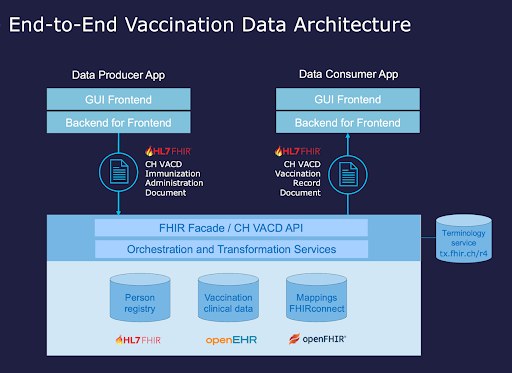
openEHR Switzerland and HL7 Switzerland have formed a joint working group to turn the vaccination showcase developed at the 2026 Swiss GovTech Hackathon into a reusable implementation blueprint. Building on the end-to-end proof of concept, the group will document the approach to openEHR® modelling, the bidirectional transformation between HL7® FHIR® documents and openEHR COMPOSITIONs using FHIRconnect and openFHIR®, and an architecture comprising a FHIR façade, orchestration and transformation services, an openEHR clinical data repository and an HL7 FHIR-based demographic server. The resulting implementation guide is intended to support future implementations in vaccination and other clinical domains.
Why combine two standards?
CH VACD, built on HL7 FHIR, defines the Swiss exchange format for vaccination data and is legally mandated for use within the Swiss Electronic Patient Record. However, a vaccination record must remain clinically usable throughout a person’s lifetime, and a document exchanged at a particular point in time is not the same as a longitudinal record maintained over decades.
openEHR provides a vendor-neutral persistence layer for structured and queryable clinical data. The archetypes that carry the clinical meaning are curated and versioned by an international clinical community, while the clinical data remain within repositories operated and controlled by the responsible healthcare organisations or infrastructures.
This separation helps preserve the clinical meaning and queryability of vaccination data as vendors, applications and exchange formats evolve. HL7 FHIR and openEHR therefore address complementary requirements: HL7 FHIR supports interoperable exchange, while openEHR supports long-term, structured clinical persistence.
From proof of concept to reusable blueprint
Using vaccination as the reference use case, the working group will validate and document the complete implementation path from FHIR-based exchange to longitudinal openEHR persistence and back. This includes clinical models, terminology bindings, mapping artefacts, demographic references, transformation logic, orchestration and architectural patterns. The aim is to create a reusable and governable blueprint that can be applied to additional clinical domains and may also support broader initiatives such as the Swiss Health Data Space (SwissHDS).
Jean-Pierre Messerli is a physician and medical informatics specialist with a long-standing focus on medical-grade information systems and practice operations. He has held senior roles across software development, management, consulting, and project leadership, and has led 152 implementations of electronic health records for medical practices and centres.
Leave a Reply