
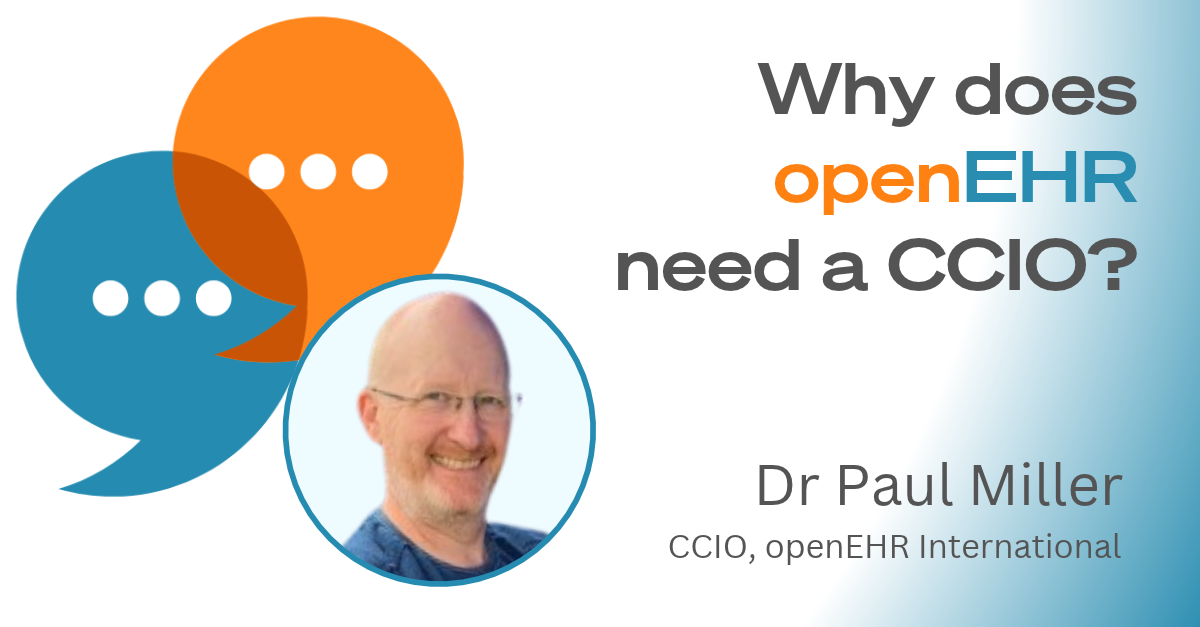
I’ve recently been appointed Chief Clinical Information Officer (CCIO) at openEHR International. I’m delighted to join the core team, and I’m particularly pleased that openEHR is investing in clinical informatics leadership in this way.
Many standards organisations have significant clinical expertise within their leadership, committees and working groups. However, few have established a dedicated CCIO role to provide clinical informatics leadership across the organisation and beyond.
I think that says something important about what openEHR is, and what we are trying to achieve.
openEHR is, at its heart, a clinically focused, clinically driven set of technologies. Embedded in its reference model is an understanding of the process of care: how clinicians work, how they interact with patients, and how clinical information is created and used throughout the care cycle. This understanding underpins the openEHR approach – enabling clinical care processes to be represented and supported in the digital world, ultimately making care easier to deliver and more effective.
One of the biggest challenges in digital health is making information understandable and usable across organisations and throughout people’s lives. Traditionally, this has been approached as a problem of exchanging information between systems. openEHR starts a step further back, asking how we should represent clinical information in the first place so its meaning can be preserved and the information safely reused and retained over time.
Crucially, this creates the opportunity to separate clinical data from the software applications that use it. It’s an approach that seems so obviously sensible that I sometimes wonder why we’re still building and buying tightly integrated, full-stack products for our public health and care systems. We can do things differently now, with modular systems built around open standards. openEHR, alongside other open standards like HL7 FHIR, plays an essential role in making that possible.
So what does this mean for my role as CCIO?
Part of it is working within openEHR International, helping shape the priorities of our team and community, and ensuring our work reflects the needs of clinicians, care providers and the people they serve. That means contributing to our strategy, specifications and clinical models, and working with the many people who develop, implement and use openEHR.
But perhaps the more important part of the role extends beyond the organisation itself. Clinicians and patients have good reason to be frustrated with the digital systems they have been given. Too often, technology has made care more complicated rather than easier. I want to help make the case for a different approach, showing how openEHR can help enable better health and care systems, and encouraging more clinicians and patients to join our community and help deliver that future.
Ultimately, this isn’t about promoting a particular standard or technology for its own sake. It’s about changing how we build digital health records and systems, so information serves people’s needs rather than the constraints of individual applications or organisations.
There’s a huge amount of expertise, enthusiasm and commitment within the openEHR community and beyond. As CCIO, I want to help bring people together to develop a shared understanding of the challenges we face, and to work on practical solutions. With openEHR, we have an opportunity to develop the shared clinical models, standards and other building blocks that can help make better digital health systems a reality. I’d love to hear from anyone interested in learning more or becoming involved.
Paul leads openEHR’s clinical strategy, ensuring clinicians’ voices remain central to everything openEHR builds. A former GP, he spent over seven years as Clinical Informatics Lead at NHS Education for Scotland, where he managed the clinical models underpinning the NHS Scotland National Digital Platform and trained the team in openEHR. In addition to his new role, he co-chairs the openEHR Clinical Program Board, with particular interests in clinical safety assessment, clinical terminologies and interoperability.
Leave a Reply