
Dr. Nils Hellrung is CEO of vitagroup and a long-standing advocate for open standards, interoperability, and sustainable healthcare data infrastructures. In this article, he explores a shift that is receiving less attention than large-scale provider adoption: the growing number of specialised healthtech vendors building innovative solutions on top of shared openEHR-based clinical data platforms.
Much of the discussion around openEHR has traditionally focused on healthcare providers, regional programmes and national initiatives adopting open standards for clinical data. But a less discussed development is taking place alongside this growth: an increasing number of specialised healthcare technology vendors are becoming part of the openEHR ecosystem.
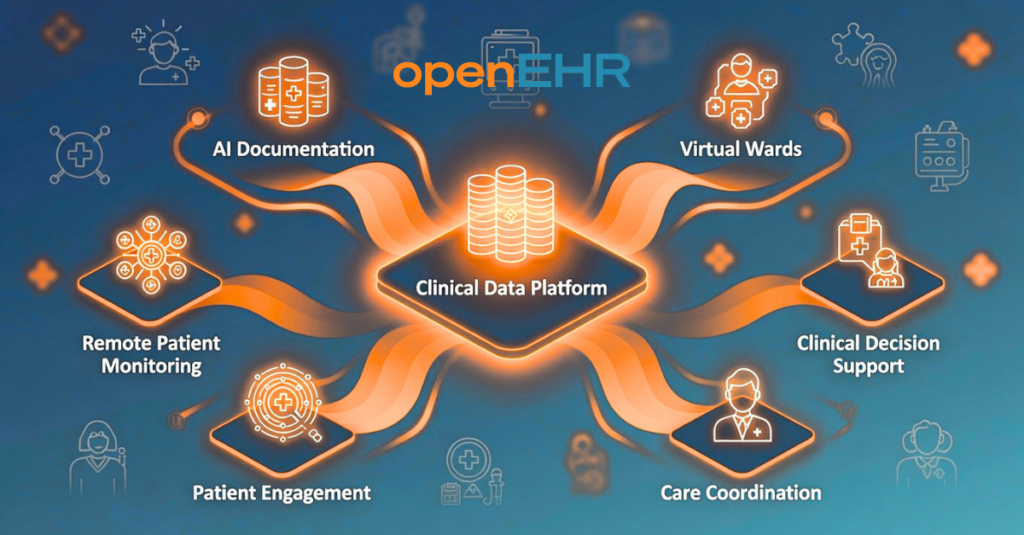
Many of these vendors build applications for specific challenges such as AI-assisted documentation, virtual wards, remote monitoring, patient engagement, clinical decision support or care coordination. Their solutions complement core openEHR platforms and CDRs by addressing well-defined clinical and operational problems.
Historically, many of these solutions were integrated separately into each hospital’s existing systems, for example a specific EHR or portal, or deployed as standalone products. This limited both portability and reuse of the data they generated, and often made every new deployment feel like a fresh integration project.
As healthcare organisations invest in shared clinical data platforms, a different model is emerging. Rather than integrating with multiple disconnected systems, application vendors can connect to a structured, reusable clinical data layer based on open standards such as openEHR. In practice, this can allow a small specialised vendor to design once against a stable set of clinical models and platform contracts, and then reach several customers that share the same foundation.
This shift creates benefits for everyone involved. Healthcare organisations gain greater flexibility when selecting specialised solutions, because applications no longer have to be tied to specific monolithic systems. Application vendors can concentrate on innovation within their domain instead of repeatedly solving the same interoperability and governance challenges in each project. Most importantly, clinical information becomes easier to reuse across workflows, organisations and use cases, because it is stored in a consistent, computable form rather than locked inside application-specific databases.
For the openEHR community, this represents an important opportunity. Every additional application vendor that builds on openEHR expands the ecosystem, increases the value of shared models and tools, and creates further reasons for healthcare organisations to invest in structured clinical data. The long-term success of openEHR will depend not only on adoption by healthcare providers, but also on the breadth and diversity of organisations that choose to innovate around a shared platform.
Leave a Reply