
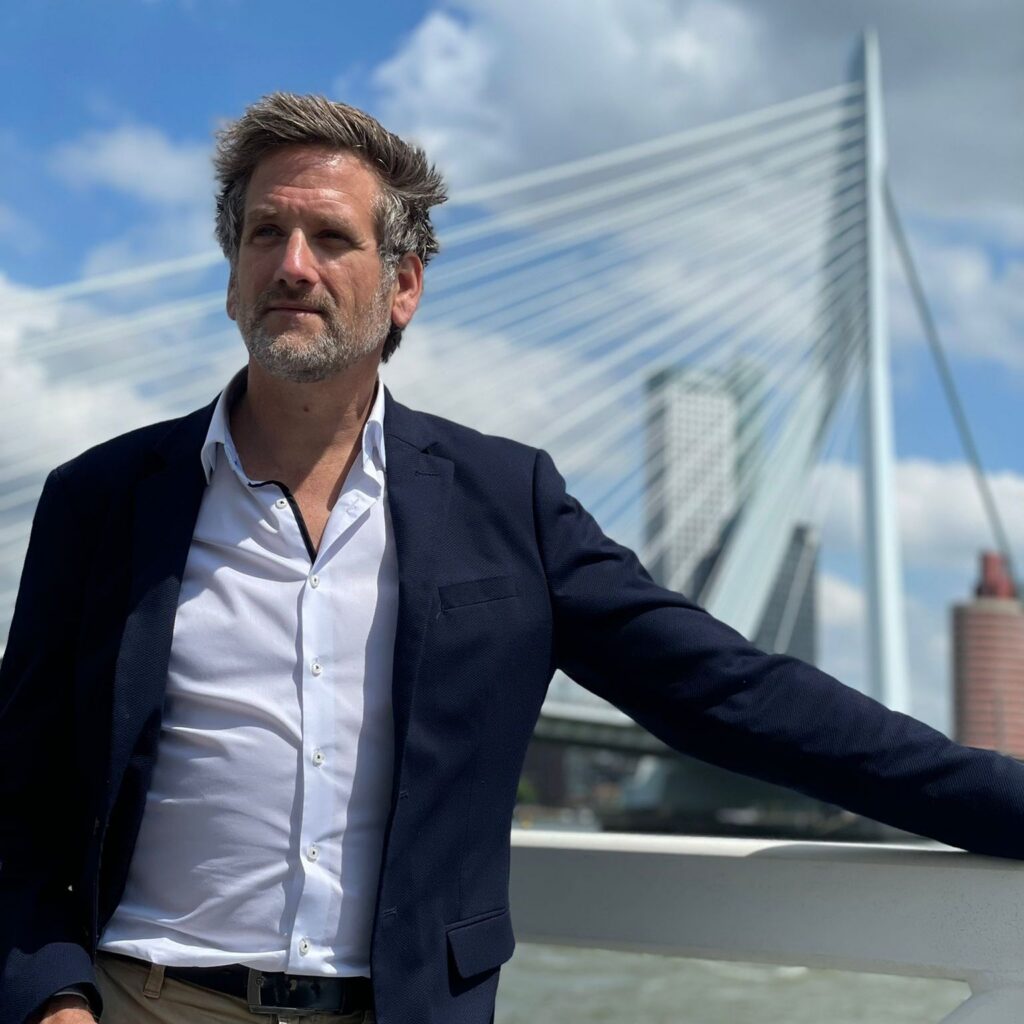
Remko Schats is a physician specialising in tropical and global health, and founder of Enigma Global eHealth, an openEHR Startup Industry Partner. With experience in malaria research, Médecins Sans Frontières and treating seafarers in Rotterdam, he is focused on developing patient-owned, interoperable health records that can travel with people across borders. He is also Vice President of FESTMIH and leads the digitalisation of the WHO International Certificate of Vaccination and Prophylaxis in the Netherlands.
Currently, an estimated 2.57 million seafarers are keeping the world’s merchant fleet of over 85,000 ships moving – carrying everything from food to fuel, to our Ali Express orders, to the components of the devices we use every day. Five countries – the Philippines, India, China, Russia and Indonesia – supply more than half of this global workforce.
A seafarer can live in Indonesia, but work for a Norwegian shipowner, sail under a Panamanian flag, and receive treatment in Rotterdam – all within the same contract. Every one of those encounters can generate its own piece of a (digital) health record, filed with a different doctor, hospital, or Telemedical Maritime Assistance Service (TMAS), in a different system, in a different country. What a seafarer typically carries on board is not a medical record but often a loose bundle of documents accumulated over a career.
The consequences are real. A new doctor, often assessing a patient remotely by radio or video, has to start from scratch – without knowing the seafarer’s medication, allergies or medical history. That can mean repeated tests, delayed or overly cautious decisions, higher costs, and longer stretches ashore for both the seafarer and the shipping company. Fatigue, physical strain, and long periods of isolation already make seafarers a vulnerable occupational group; fragmented medical information adds an avoidable layer of risk on top of that. And perhaps most strikingly, the people this problem affects most directly – the seafarers themselves – have the least influence over how their own medical data is collected, stored or shared.
Why this matters to me
I am a physician with a background in tropical and global health. After two years of surgical training and a tropical medicine programme in the Netherlands, I worked at a rural hospital in Ghana and with Médecins Sans Frontières in a refugee camp on the Chad–Sudan border, later working on malaria prevention in Indonesia post-tsunami before completing a PhD on malaria vaccine research at Leiden University Medical Centre. Back in the Netherlands, I worked for several years as a physician for the Port Health Centre (PHC) in Rotterdam, where I treated seafarers directly. It was there that the gap in their medical records became impossible to ignore.
That experience led me to found Enigma Global eHealth during my executive MBA at Erasmus University Rotterdam, where I first mapped out what a truly patient-owned, borderless health record could look like. Three years ago, I became an openEHR startup industry partner – not as an add-on, but because openEHR is the foundation my entrepreneurial plans are built on. An open, vendor-neutral standard is the only way to build a health record that can genuinely scale across doctors, hospitals, employers and countries, rather than locking patients into one system. Because openEHR separates clinical content from the underlying software, a seafarer’s record can, in principle, remain readable, portable and interoperable wherever in the world they next need care.
The future of digital health is open!
Alongside this, I am the initiator of the digitalisation of the WHO International Certificate of Vaccination and Prophylaxis (ICVP) – the “Yellow Card” – in the Netherlands, and I currently serve as Vice President of FESTMIH, the Federation of European Societies for Tropical Medicine and International Health. I’m also working with the Erasmus School of Health Policy & Management on the broader digital-health questions this work raises: who should see what part of a medical record, and how much access is appropriate for a ship’s captain versus a treating physician versus the seafarer.
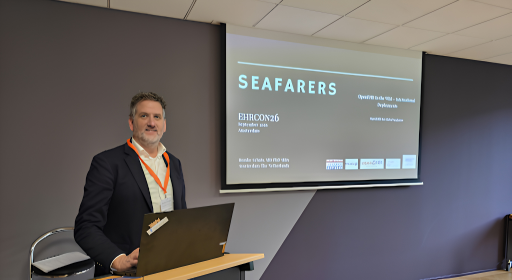
I was grateful for the invitation to speak at openEHR’s EHRCON26 conference in Amsterdam last week, in the track ‘openEHR in the Wild – International Deployments. It was encouraging to hear that the presentation on openEHR for Global Seafarers was received so well by the community.
Where openEHR comes in
What draws me to openEHR is not only the technical model but the community around it: an international network of clinicians, developers and health organisations already solving very similar interoperability problems in dozens of countries. Seafarers are, in a sense, an extreme case of the portability problem every health system is trying to solve – they simply cross more borders, faster, than almost anyone else, all while staying away from home for extended periods.
I believe there is a real opportunity here for the openEHR community to make a tangible difference for a workforce that keeps global trade running but has been largely overlooked in the digital health conversation. I’d welcome hearing from anyone in this community working on cross-border interoperability, maritime or global health, or patient-owned records – who see the same gap from their side of the problem.
If this resonates with your work, I’d love to connect.
Leave a Reply